
When you want to say that someone understands an idea, concept, instruction, or situation, “grasp” is a useful word. However, repeating the same term too often can make your writing sound unnatural. Depending on the context, alternatives such as understand, comprehend, get, figure out, master, recognize, perceive, and make sense of can communicate similar ideas with slightly different meanings.
Choosing the right synonym depends on what you want to express. Some alternatives are suitable for formal writing, while others sound more natural in everyday conversations. This guide explains the meaning of the word, provides 20 useful alternatives, and shows how to choose the best option for different situations.
What Does “Grasp” Mean?
“Grasp” means to understand something clearly, especially an idea, concept, situation, or information. It can also mean to physically hold something firmly. When used in the sense of understanding, it often suggests that a person has developed a clear enough understanding of something to follow or use it effectively.
20 Synonyms and Other Words for “Grasp”
Here are 20 useful alternatives, with explanations and examples to help you choose the right word.
1. Understand
Understand is the most common and versatile alternative. It means to know what something means or how something works.
Example:
I understand the main idea of the presentation.
It works well in both formal and informal communication.
2. Comprehend
Comprehend means to understand something fully or clearly. It is more formal than “understand” and is often used in academic, professional, and written contexts.
Example:
Students must comprehend the instructions before starting the assignment.
Use this word when you want your writing to sound precise and formal.
3. Get
Get is an informal alternative commonly used in everyday conversation. It can mean understanding an idea, explanation, or situation.
Example:
I get what you mean now.
Although natural in conversation, it may sound too casual for some formal documents.
4. Figure Out
Figure out means to understand, discover, or solve something after thinking about it.
Example:
She finally figured out how the new software works.
It is especially useful when understanding requires some effort or problem-solving.
5. Master
Master means to develop a high level of understanding or skill in something. It usually suggests more than simply understanding an idea.
Example:
He mastered the basic principles of accounting.
Use it when the context involves learning, skill, or expertise.
6. Follow
Follow can mean to understand what someone is saying or explaining, especially during a conversation, presentation, or discussion.
Example:
I followed your explanation until the final section.
This alternative is particularly natural when discussing spoken explanations.
7. Perceive
Perceive means to become aware of or recognize something through observation or thought. It is more formal than everyday alternatives.
Example:
She quickly perceived the main issue with the proposal.
It works well when understanding involves recognizing something that is not immediately obvious.
8. Recognize
Recognize means to identify or become aware of something. It can work as an alternative when the focus is on identifying an idea, fact, pattern, or situation.
Example:
He recognized the importance of clear communication.
Use it when the emphasis is on awareness rather than complete understanding.
9. Make Sense Of
Make sense of means to understand something that initially seems confusing, complicated, or unclear.
Example:
It took me some time to make sense of the new instructions.
This phrase is especially useful in everyday and professional communication.
10. Absorb
Absorb can mean to take in and understand information, especially when someone is learning a large amount of material.
Example:
The students quickly absorbed the information presented during the workshop.
It emphasizes taking information in rather than simply recognizing it.
11. Take In
Take in means to understand or process information. It is often used when someone receives a lot of information at once.
Example:
There was so much information that I needed time to take it all in.
This phrase sounds natural in everyday communication.
12. Catch On
Catch on means to begin to understand something, especially after initially finding it difficult.
Example:
Once she saw the example, she quickly caught on.
It is generally informal and works best in conversations.
13. Get the Hang of It
Get the hang of it means to gradually learn how to do something or understand how it works.
Example:
After a few practice sessions, I got the hang of the new system.
This expression is informal and is often used when talking about learning a practical skill.
14. Learn
Learn can sometimes replace the main term when the focus is on gaining knowledge or understanding through study or experience.
Example:
She learned how the process works after reviewing the instructions.
However, “learn” focuses more on gaining knowledge, while the original term often emphasizes understanding.
15. Identify
Identify means to recognize or determine what something is. It can work as an alternative when the meaning involves recognizing a particular issue, fact, or element.
Example:
The manager identified the main problem with the project.
Use it when the emphasis is on recognizing something specific.
16. Interpret
Interpret means to explain or understand the meaning of information, language, behavior, or events.
Example:
She interpreted the message differently from her colleagues.
This word is particularly useful when the subject involves meaning or analysis.
17. Appreciate
Appreciate can mean to understand the value, importance, or significance of something.
Example:
He appreciates the importance of meeting the deadline.
It is a good choice when the intended meaning involves recognizing significance.
18. Discern
Discern means to recognize or understand something that may be difficult to notice or distinguish.
Example:
The analyst could discern a clear pattern in the data.
It is a formal word that works especially well in analytical or professional writing.
19. Master the Basics
Master the basics means to develop a strong understanding of the fundamental parts of a subject.
Example:
Before moving to advanced lessons, students should master the basics.
This phrase is more specific because it focuses on foundational knowledge.
20. Get the Idea
Get the idea means to understand the main point or meaning of something.
Example:
I think you get the idea now.
It is informal and works well in casual conversations and simple explanations.
How to Choose the Best Synonym
The best alternative depends on the exact meaning you want to communicate.
Use understand when you want a general and natural word. Choose comprehend when you need a more formal expression. Use get for casual conversations and figure out when understanding involves solving a problem.
If the context involves developing a skill, master may be more appropriate. When you are recognizing the importance of something, appreciate can work better. For unclear information, make sense of is often a natural choice.
Always consider the tone, audience, and level of understanding before choosing an alternative.
“Grasp” vs. “Understand”: What’s the Difference?
“Grasp” and “understand” are closely related, but they can have slightly different emphasis.
Understand is the broader and more common word. It can describe basic, partial, or complete knowledge.
The original term can emphasize achieving a clear understanding of an idea, concept, or situation.
Example:
- I understand the instructions.
- I finally grasped the main concept.
In most situations, “understand” is the safest general alternative.
“Grasp” vs. “Comprehend”: Which Word Is Better?
Both words mean to understand something, but “comprehend” tends to sound more formal.
The original term is natural in professional communication and everyday speech, while “comprehend” is more common in academic or formal writing.
Example:
- She grasped the basic concept quickly.
- Students must comprehend the material before taking the examination.
Choose based on tone rather than meaning alone.
“Grasp” vs. “Get”: Formal or Casual?
“Get” is much more informal than the original term.
For example:
Casual:
I get what you’re saying.
More professional:
I grasp what you are explaining.
In workplace emails, academic writing, reports, and formal documents, “understand,” or the original term, is usually more appropriate than “get.”
“Grasp” vs. “Master”: Understanding vs. Expertise
The original term generally means understanding something, while “master” suggests a much higher level of knowledge, ability, or control.
For example:
- She grasped the basic concept.
- She mastered the entire technique.
Someone can understand an idea without mastering the subject. Therefore, these words should not always be treated as exact synonyms.
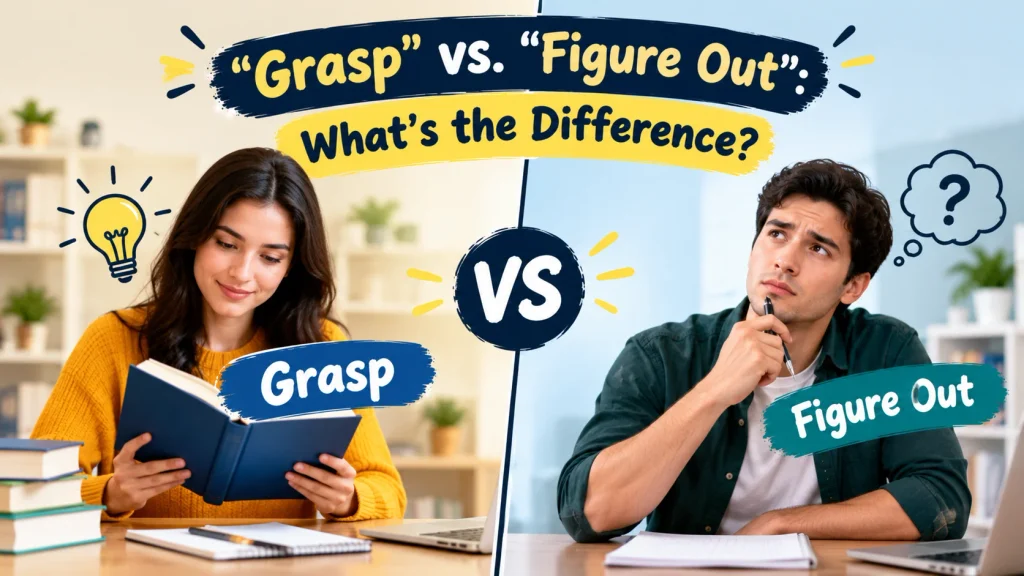
“Grasp” vs. “Figure Out”: What’s the Difference?
“Figure out” usually suggests reaching an understanding after thinking, investigating, or solving a problem.
The original term focuses more directly on understanding.
Example:
- I grasp the concept now.
- I figured out how the system works.
Use “figure out” when there is a process of discovery or problem-solving.
When Should You Use the Word “Grasp”?
Use “grasp” when you want to describe a person’s ability to understand an idea, concept, situation, instruction, or piece of information.
It is particularly useful when discussing complex subjects or ideas that require clear understanding.
For example:
- She quickly grasped the main concept.
- Do you grasp what the instructions mean?
- He has a good grasp of financial principles.
- The team needs to grasp the potential risks.
It is appropriate in professional, academic, and everyday contexts.
When Should You Use an Alternative?
An alternative may be better when you want to communicate a more specific meaning or create variation in your writing.
For example, use “comprehend” for formal academic writing, “get” for casual conversation, “master” for advanced skill, and “figure out” for problem-solving.
You may also choose another expression when the main term appears repeatedly in the same paragraph or article. Strategic variation can make your writing sound more natural without changing the intended meaning.
Is “Grasp” Formal, Professional, or Casual?
“Grasp” is generally considered neutral and professional. It can be used in workplace communication, academic writing, presentations, reports, and everyday conversations.
For example:
Professional:
The team needs to grasp the potential impact of the change.
Academic:
Students must grasp the fundamental principles of the subject.
Everyday:
I don’t quite grasp what you mean.
Because it works across different settings, it is a versatile word.
Common Mistakes When Using “Grasp”
Using “Grasp” Instead of “Know”
“Grasp” and “know” are not always interchangeable.
For example, saying someone knows a person does not mean they “grasp” that person. The term generally refers to understanding an idea, concept, situation, or meaning.
Using “Grasp” for Every Type of Understanding
Although it is a useful synonym for “understand,” it may not be the best choice in every situation.
For example, “recognize” is better when identifying something, while “master” is better when describing advanced skill.
Confusing the Physical and Figurative Meanings
The word has both a physical and an intellectual meaning.
Physical:
She grasped the handle tightly.
Intellectual:
He grasped the main idea quickly.
The surrounding context determines which meaning is intended.
Choosing “Grasp” When a More Precise Word Is Better
Sometimes a more specific alternative communicates your meaning more accurately.
For example:
- Figure out → solving or discovering something
- Master → achieving strong skill
- Recognize → becoming aware of something
- Interpret → explaining meaning
- Comprehend → fully understanding information
Using the most precise word improves clarity.
Examples of “Grasp” in Different Contexts
In the Workplace
The new employee quickly grasped the company’s reporting process.
In an Email
I hope this explanation helps you grasp the main changes to the policy.
In a Meeting
Before we continue, does everyone grasp the purpose of this proposal?
In Education
Students must grasp the fundamental principles before studying advanced topics.
In Everyday Conversation
I don’t think I fully grasp what you’re trying to say.
In a Presentation
The speaker used simple examples to help the audience grasp the complex topic.
Comparison Table: 20 Best Alternatives
| Alternative | Meaning | Tone | Best Used For |
| Understand | Know the meaning | Neutral | General situations |
| Comprehend | Understand fully | Formal | Academic writing |
| Get | Understand | Casual | Conversations |
| Figure Out | Discover or understand | Casual | Problems and solutions |
| Master | Understand and become skilled | Neutral/Formal | Skills and subjects |
| Follow | Understand an explanation | Neutral | Conversations |
| Perceive | Become aware of | Formal | Analysis |
| Recognize | Identify or become aware | Neutral | Facts and patterns |
| Make Sense Of | Understand something unclear | Neutral | Confusing information |
| Absorb | Take in information | Neutral | Learning |
| Take In | Process information | Casual/Neutral | Explanations |
| Catch On | Begin to understand | Casual | Learning |
| Get the Hang of It | Learn how something works | Casual | Practical skills |
| Learn | Gain knowledge | Neutral | Education |
| Identify | Recognize something | Neutral/Formal | Specific issues |
| Interpret | Understand meaning | Formal | Text and information |
| Appreciate | Understand importance | Neutral/Formal | Value or significance |
| Discern | Recognize something subtle | Formal | Analysis |
| Master the Basics | Learn fundamentals well | Neutral | Education and training |
| Get the Idea | Understand the main point | Casual | Conversations |
Which Synonym Is Best?
The best synonym depends on your intended meaning and tone.
For general writing, understand is usually the safest choice. For formal or academic contexts, comprehend may be more suitable. In casual conversations, get and catch on sound natural.
If you are describing problem-solving, use figure out. If you are describing advanced ability, choose master. When the focus is on importance or value, appreciate may be more precise.
The key is not simply to replace one word with another. Instead, choose the alternative that communicates your exact meaning and fits naturally into the sentence.
Conclusion:
“Grasp” is a versatile word that can describe understanding an idea, concept, instruction, or situation. However, the best synonym depends on the context, tone, and level of understanding you want to express. Understand is the most flexible alternative, while comprehend is more formal. Get and catch on work well in casual conversations, whereas figure out suggests problem-solving. If you want to describe advanced knowledge or ability, master is usually more accurate.
Other useful alternatives include recognize, perceive, interpret, absorb, appreciate, discern, and make sense of. Each word has its own shade of meaning, so replacing the same term should always be based on context rather than simple word matching.
Whether you are writing an email, preparing an academic assignment, creating professional content, or having an everyday conversation, choosing the right alternative can make your communication clearer and more natural. Understanding these distinctions allows you to use the word and its synonyms with greater confidence and precision.
FAQs
What is another word for “grasp”?
The most common alternative is understand. Depending on the context, you can also use comprehend, get, figure out, recognize, perceive, follow, master, interpret, or make sense of. The best choice depends on whether you are describing general understanding, formal comprehension, problem-solving, or advanced knowledge.
What is a professional synonym for “grasp”?
Understand, comprehend, recognize, perceive, and interpret can work as professional alternatives. The best choice depends on the sentence. “Understand” is the most natural general option, while “comprehend” and “perceive” can sound more formal in academic or professional writing.
Is “understand” the same as “grasp”?
“Understand” and “grasp” have very similar meanings, but “grasp” can emphasize achieving a clear understanding of an idea or concept. “Understand” is broader and more commonly used. In many sentences, they can be used interchangeably, but the exact choice depends on the context and desired tone.
Is “grasp” a formal word?
“Grasp” is a neutral word that can be used in both formal and informal contexts. It is common in professional communication, academic writing, presentations, and everyday conversations. It is neither strongly formal nor strongly casual, which makes it a flexible choice when describing understanding.
What is a casual synonym for “grasp”?
Get is one of the most common casual alternatives. Other informal choices include catch on, get the idea, and get the hang of it. These expressions are especially natural in conversations, although they may not be appropriate for every formal or academic context.
What is the difference between “grasp” and “comprehend”?
Both words mean to understand something, but “comprehend” generally sounds more formal. “Grasp” is natural in both professional and everyday communication, while “comprehend” is often associated with academic or formal writing. Both can describe clear understanding of information, ideas, or concepts.
Can “master” replace “grasp”?
Sometimes, but they are not exact synonyms. “Grasp” usually means to understand something, while “master” suggests achieving a high level of knowledge or skill. Someone can grasp the basics of a subject without mastering it. Therefore, use “master” when the context involves advanced ability or expertise.
What is another phrase for “grasp the concept”?
Useful alternatives include understand the concept, comprehend the concept, get the idea, make sense of the concept, and figure out the concept. “Understand the concept” is the most natural general alternative, while “comprehend the concept” sounds more formal.
What is the difference between “grasp” and “figure out”?
“Grasp” focuses on understanding, while “figure out” usually suggests reaching an answer or understanding through thinking, investigation, or problem-solving. For example, you might “grasp the concept” after an explanation, but you might “figure out” how a complicated system works.
What is the best synonym for “grasp” in academic writing?
Understand and comprehend are strong choices for academic writing. “Comprehend” is more formal, while “understand” is more natural and widely used. Depending on the context, interpret, perceive, recognize, or master may be more precise when the sentence describes a specific type of academic understanding.