
Imagine walking into a room where everyone seems tired or serious, then noticing someone whose smile immediately makes the atmosphere feel lighter. Their expression encourages others to relax, respond warmly, or even smile themselves. This is the idea behind an infectious smile, a phrase that describes a smile with a noticeable positive effect on the people around it.
The best alternative depends on what you want to emphasize. “Contagious smile” focuses on spreading happiness, while “warm smile” suggests kindness and comfort. Other options, such as “genuine smile,” “welcoming smile,” or “radiant smile,” highlight sincerity, approachability, or brightness. Understanding these differences can help you choose a more natural expression for everyday conversation, professional writing, profiles, and social media.
What Does “Infectious Smile” Mean?
A smile that naturally makes other people feel happier, more comfortable, or inclined to smile themselves can be described as an infectious smile. The word “infectious” is used figuratively rather than medically. It suggests that positive emotions seem to spread from one person to another through facial expressions and social interaction.
Why Is “Infectious” Used to Describe a Smile?
The word “infectious” originally relates to the spread of disease, but English often uses it metaphorically for emotions and behaviors. Expressions such as “infectious laughter” and “infectious enthusiasm” follow the same pattern.
In this context, “infectious” suggests that a person’s positive mood influences the people around them. The phrase therefore describes social impact rather than physical transmission. It is generally positive and is commonly used when describing someone’s personality, presence, attitude, or emotional effect on others.
Best Alternatives to “Infectious Smile”
Contagious Smile
A contagious smile is a smile that makes other people want to smile too. It is one of the closest alternatives because both expressions focus on emotional influence.
Best for: Casual conversation, social media, and personal descriptions.
Example: “Her contagious smile made everyone at the party feel more cheerful.”
Warm Smile
A warm smile communicates kindness, friendliness, and emotional comfort. Unlike “infectious,” it does not necessarily suggest that other people start smiling.
Best for: Professional communication, introductions, workplace descriptions, and personal writing.
Example: “He greeted the new employees with a warm smile.”
Genuine Smile
A genuine smile emphasizes sincerity and authenticity. It suggests that the person’s happiness or friendliness appears natural rather than forced.
Best for: Profiles, recommendations, professional descriptions, and personal writing.
Example: “Her genuine smile made the conversation feel comfortable from the beginning.”
Welcoming Smile
A welcoming smile suggests openness, friendliness, and approachability. It is particularly useful when describing someone who makes others feel comfortable.
Best for: Customer service, meetings, introductions, and workplace communication.
Example: “The receptionist greeted every visitor with a welcoming smile.”
Friendly Smile
A friendly smile simply communicates friendliness and pleasantness. It is straightforward and works in a wide range of everyday situations.
Best for: Conversations, workplace descriptions, profiles, and informal writing.
Example: “He gave me a friendly smile before taking his seat.”
Radiant Smile
A radiant smile emphasizes brightness, beauty, and visible happiness. It is more expressive and complimentary than “friendly smile.”
Best for: Personal descriptions, photographs, social media, and creative writing.
Example: “She appeared in the photograph with a radiant smile.”
Bright Smile
A bright smile suggests cheerfulness, positive energy, and a visibly happy expression. It can also describe an attractive or noticeable smile.
Best for: Profiles, casual descriptions, captions, and personal writing.
Example: “His bright smile made him stand out in the group photo.”
Joyful Smile
A joyful smile emphasizes strong happiness or delight. It is useful when the person’s emotional state is more important than their influence on others.
Best for: Celebrations, personal stories, emotional descriptions, and photographs.
Example: “She greeted her family with a joyful smile after returning home.”
Cheerful Smile
A cheerful smile describes an expression that reflects happiness and a positive attitude. It is simple, natural, and easy to use.
Best for: Everyday conversation, workplace descriptions, and general writing.
Example: “His cheerful smile lifted the mood during the long meeting.”
Uplifting Smile
An uplifting smile suggests that someone’s expression improves the mood or gives encouragement to others.
Best for: Supportive situations, personal descriptions, and inspirational writing.
Example: “Her uplifting smile gave everyone confidence before the presentation.”
Winning Smile
A winning smile describes an appealing, confident, or charming smile that creates a favorable impression.
Best for: Personal profiles, interviews, promotional writing, and informal descriptions.
Example: “His winning smile helped him make a strong first impression.”
Charming Smile
A charming smile emphasizes attractiveness, appeal, and pleasant personality. It does not necessarily mean that the smile affects everyone emotionally.
Best for: Personal descriptions, social media, and creative writing.
Example: “Her charming smile made her easy to remember.”
Heartwarming Smile
A heartwarming smile suggests that someone’s expression creates feelings of affection, happiness, or emotional warmth.
Best for: Family stories, personal writing, emotional moments, and social media.
Example: “The child gave his grandmother a heartwarming smile.”
Kind Smile
A kind smile communicates gentleness, compassion, and goodwill. It is especially useful when the person’s caring nature is the main point.
Best for: Personal descriptions, supportive situations, and professional communication.
Example: “She offered a kind smile to the nervous student.”
Reassuring Smile
A reassuring smile helps another person feel calmer, safer, or more confident. It focuses on comfort rather than general happiness.
Best for: Difficult conversations, healthcare, customer service, meetings, and supportive situations.
Example: “The manager gave him a reassuring smile before the interview began.”
Engaging Smile
An engaging smile suggests that someone is approachable and able to create a sense of connection with others.
Best for: Professional profiles, presentations, interviews, and networking.
Example: “Her engaging smile helped the audience feel connected to the speaker.”
Pleasant Smile
A pleasant smile is a neutral and polite way to describe an attractive or agreeable expression. It is less emotional than “infectious smile.”
Best for: Professional descriptions, general writing, and neutral contexts.
Example: “The employee maintained a pleasant smile throughout the meeting.”
Encouraging Smile
An encouraging smile communicates support and gives another person confidence or motivation.
Best for: Teaching, coaching, teamwork, presentations, and supportive interactions.
Example: “The teacher gave the student an encouraging smile before the exam.”
Positive Smile
A positive smile emphasizes a favorable, optimistic, or upbeat impression. Although less idiomatic than some alternatives, it can work when discussing overall attitude.
Best for: Professional descriptions, workplace communication, and general discussions of attitude.
Example: “His positive smile helped create a relaxed workplace atmosphere.”
Expressive Smile
An expressive smile highlights how clearly a person’s smile communicates emotion or personality. It does not necessarily imply that others respond in the same way.
Best for: Creative writing, photography, profiles, and descriptions of facial expressions.
Example: “Her expressive smile showed exactly how excited she was.”
How to Choose the Right Alternative
Choosing the best phrase depends on the specific quality you want to describe.
For emotional influence: “contagious smile” or “infectious smile”
For kindness and comfort: “warm smile” or “kind smile”
For sincerity: “genuine smile”
For approachability: “welcoming smile” or “friendly smile”
For brightness and happiness: “radiant smile” or “bright smile”
For encouragement: “uplifting smile” or “encouraging smile”
For calm and support: “reassuring smile”
For attractiveness or appeal: “charming smile” or “winning smile”
For professional settings: “warm smile,” “welcoming smile,” or “engaging smile”
For creative descriptions: “radiant smile,” “heartwarming smile,” or “expressive smile”
The key is to match the alternative with the exact quality you want the reader to notice.
When Should You Use “Infectious Smile”?
The expression works well when you want to emphasize the effect someone’s smile has on other people. It is especially natural in personal descriptions, conversations, social media captions, profiles, interviews, and friendly workplace communication.
For example, saying “Her infectious smile made everyone feel welcome” communicates more than the fact that she smiled. It suggests that her expression positively influenced the atmosphere around her.
When Should You Avoid “Infectious Smile”?
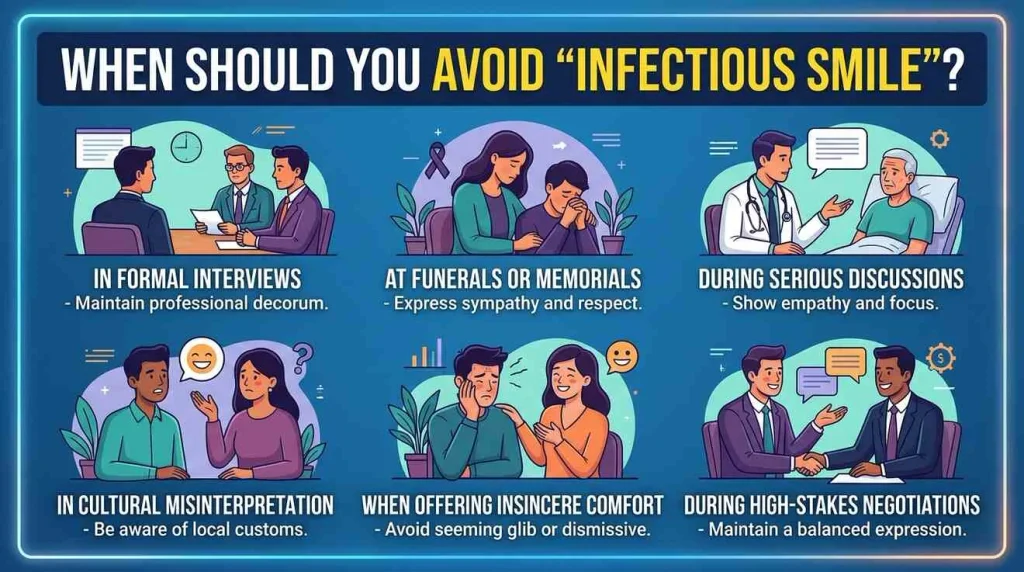
Although the phrase is positive, it may not be the best choice when you need highly objective or formal language. Academic, legal, technical, and strictly factual writing may benefit from more precise wording.
It is also better to choose another expression when you specifically mean sincerity, appearance, kindness, or reassurance. For example, “genuine smile” is more precise when authenticity matters, while “radiant smile” is better when brightness or attractiveness is the focus.
Is “Infectious Smile” Professional or Casual?
“Infectious smile” can be used professionally, but it has a warm and expressive quality. It can work naturally in employee profiles, recommendations, interviews, networking messages, and friendly workplace communication.
For highly formal writing, alternatives such as “welcoming smile,” “friendly smile,” or a phrase describing someone’s positive demeanor may sound more neutral. The right choice depends on the relationship, purpose, and level of formality.
“Infectious Smile” in American and British English
The expression is naturally understood in both American and British English. There is no major difference in its basic meaning.
American and British speakers can use the phrase in personal descriptions, conversations, profiles, interviews, and informal professional contexts. As with most descriptive expressions, the naturalness depends more on context and writing style than on regional English differences.
Examples of “Infectious Smile” in Different Contexts
Professional Setting
“Her infectious smile helped create a relaxed atmosphere during the team meeting.”
This works when the writer wants to highlight the person’s positive influence on colleagues.
Everyday Conversation
“You have such an infectious smile. Everyone starts smiling when you do.”
This sounds natural in friendly spoken English.
Social Media Caption
“An infectious smile can make even an ordinary day feel special.”
The phrase works well in captions that focus on happiness and positive energy.
Professional Profile
“Known for her infectious smile and approachable personality, she builds strong connections with clients.”
Here, the expression helps communicate friendliness and interpersonal appeal.
Story Writing
“Despite the difficult morning, Daniel walked into the room with his infectious smile, instantly changing the mood.”
This example shows the emotional influence of the expression within a narrative.
“Infectious Smile” vs. Similar Expressions
Infectious Smile vs. Contagious Smile
These two expressions are extremely close in meaning. Both suggest that one person’s smile encourages positive reactions in others. “Contagious smile” can sound slightly more casual and playful, while “infectious smile” can feel more expressive.
Infectious Smile vs. Warm Smile
A “warm smile” focuses on kindness, friendliness, and comfort. An “infectious smile” focuses more strongly on the effect the smile has on other people. Someone can have a warm smile without causing others to smile.
Infectious Smile vs. Genuine Smile
A “genuine smile” emphasizes sincerity and authenticity. An “infectious smile” describes social influence instead. A smile can be infectious without the writer specifically claiming that it is genuine.
Infectious Smile vs. Radiant Smile
A “radiant smile” focuses on brightness, attractiveness, and visible happiness. An “infectious smile” focuses on emotional impact. Choose “radiant” when appearance is important and “infectious” when the response of others matters.
Infectious Smile vs. Welcoming Smile
A “welcoming smile” suggests openness and approachability. It is particularly useful in professional, customer-facing, and social situations. An “infectious smile” has a stronger emphasis on spreading positive feelings.
Infectious Smile vs. Reassuring Smile
A “reassuring smile” helps someone feel calm, safe, or confident. It is more specific than “infectious smile” and is useful in supportive situations. Choose it when the main effect is comfort rather than general happiness.
Common Mistakes When Using “Infectious Smile”
Using It Only to Describe Appearance
The expression mainly describes social or emotional impact, not simply physical attractiveness. If appearance is the focus, “radiant smile” or “bright smile” may be more accurate.
Assuming It Always Means Genuine
“Infectious” describes the effect of a smile, not necessarily whether the emotion behind it is sincere. Use “genuine smile” when authenticity is the specific point.
Using It in Extremely Formal Writing
The phrase is positive but expressive. Highly formal documents may require more objective language, especially when personal impressions are not relevant.
Repeating the Same Expression
Using “infectious smile” repeatedly can make an article or description sound monotonous. Choosing precise alternatives improves variety and makes the writing more natural.
Taking “Infectious” Literally
In this expression, “infectious” is figurative. It does not refer to illness or physical transmission. The intended meaning is that a positive emotional response seems to spread from one person to another.
Is “Infectious Smile” Suitable for Digital Communication?
Yes. The expression works particularly well in social media captions, online profiles, personal websites, messages, and informal professional communication. Its vivid meaning allows writers to describe someone’s positive personality without using a long explanation.
For example, “Your infectious smile made the whole event brighter” sounds natural in a social post or personal message. In a formal business document, however, “welcoming smile” or “friendly demeanor” may be more appropriate.
Quick Comparison of the Alternatives
| Alternative | Main Meaning | Best Context |
| Contagious Smile | Makes others want to smile | Casual and social |
| Warm Smile | Shows kindness and comfort | Professional and personal |
| Genuine Smile | Shows sincerity | Profiles and descriptions |
| Welcoming Smile | Shows openness | Meetings and customer service |
| Friendly Smile | Shows friendliness | Everyday conversation |
| Radiant Smile | Shows brightness and joy | Social media and personal writing |
| Bright Smile | Shows cheerfulness | Profiles and captions |
| Joyful Smile | Shows strong happiness | Celebrations and stories |
| Cheerful Smile | Shows a happy attitude | Everyday and workplace use |
| Uplifting Smile | Improves someone’s mood | Encouragement and support |
| Winning Smile | Shows confidence and appeal | Profiles and introductions |
| Charming Smile | Shows attractiveness and appeal | Personal descriptions |
| Heartwarming Smile | Creates emotional warmth | Family and personal stories |
| Kind Smile | Shows compassion | Supportive situations |
| Reassuring Smile | Creates calm and confidence | Difficult or supportive situations |
| Engaging Smile | Encourages connection | Professional settings |
| Pleasant Smile | Gives a polite impression | Neutral descriptions |
| Encouraging Smile | Gives support or confidence | Teaching and teamwork |
| Positive Smile | Suggests optimism | Workplace and general writing |
| Expressive Smile | Communicates emotion clearly | Creative writing and profiles |
Conclusion
More than a simple facial expression, an infectious smile describes the positive effect a smile can have on the people around it. The phrase is especially useful when someone’s happiness, warmth, or positive energy seems to influence others. However, it is not the best choice for every situation. “Contagious smile” is the closest alternative, while “warm smile” focuses on kindness, “genuine smile” on sincerity, and “welcoming smile” on approachability.
Other options such as “radiant,” “reassuring,” “encouraging,” and “charming smile” provide more specific meanings. Choosing the right expression depends on the quality you want to communicate and the tone of your writing. In casual conversation and personal descriptions, expressive alternatives can sound natural and engaging. For professional communication, softer choices may be more suitable. Understanding these differences helps you avoid repetition, express ideas more precisely, and make your English sound natural across different contexts.
FAQs
What does “infectious smile” mean?
An “infectious smile” describes a smile that has a positive effect on other people and may encourage them to smile or feel happier. The word “infectious” is figurative rather than medical. It suggests that positive emotions appear to spread through social interaction.
Is “infectious smile” a compliment?
Yes. “Infectious smile” is generally a positive compliment. It suggests that someone’s smile is cheerful, appealing, and capable of improving the mood around them. The expression can describe both the person’s pleasant expression and the positive emotional effect it has on other people.
What is another word for “infectious smile”?
“Contagious smile” is the closest common alternative. Other options include “warm smile,” “genuine smile,” “welcoming smile,” “friendly smile,” “radiant smile,” “cheerful smile,” and “reassuring smile.” The best choice depends on whether you want to emphasize influence, kindness, sincerity, appearance, or emotional support.
Is “contagious smile” the same as “infectious smile”?
They have almost the same meaning. Both describe a smile that seems to make other people respond positively or smile themselves. “Contagious smile” can sound slightly more casual and playful, while “infectious smile” can sound more expressive. Both are natural and widely understood in English.
Is “infectious smile” professional?
It can be professional when used in a suitable context, such as a recommendation, profile, interview, or friendly workplace description. However, it is somewhat expressive. In highly formal writing, “welcoming smile,” “friendly expression,” or a more objective description may be a better choice.
Can I use “infectious smile” in an email?
Yes, especially in a friendly or personal email. For example, “Your infectious smile made everyone feel welcome” sounds warm and natural. In a highly formal business email, a less expressive phrase may be preferable. The relationship with the recipient and the purpose of the message should guide your choice.
What is the difference between an infectious smile and a genuine smile?
An infectious smile focuses on the effect a smile has on other people, while a genuine smile focuses on sincerity and authenticity. A person may have a genuine smile that does not noticeably affect others, or an infectious smile whose social impact is clear without the writer making a claim about sincerity.
What is the difference between an infectious smile and a radiant smile?
An infectious smile emphasizes emotional influence, while a radiant smile emphasizes brightness, attractiveness, or visible happiness. Use “infectious” when you want to show that the smile affects others. Choose “radiant” when you mainly want to describe how bright or beautiful the smile appears.
Can “infectious smile” be used in a professional profile?
Yes. The expression can work well in a professional profile when the goal is to describe approachability, positive energy, or interpersonal skills. For example, “She is known for her infectious smile and approachable communication style” creates a friendly impression while still fitting many professional contexts.
Which alternative is best for formal writing?
“Warm smile,” “welcoming smile,” or “friendly smile” can be safer choices for professional and formal descriptions. If you need to emphasize sincerity, “genuine smile” is more precise. The best alternative depends on the exact quality you want to communicate rather than simply replacing the phrase with a general synonym.