
Imagine a coworker explains the same instruction twice, but the other person still seems unsure about what to do. In a casual conversation, someone might respond with, “Are you dense?” The phrase is short and easy to understand, but it carries more than a simple comprehension question. Depending on the speaker’s tone, it can sound sarcastic, impatient, insulting, or even playful between close friends.
“Are you dense?” generally asks whether someone is having difficulty understanding something that the speaker believes should be obvious. Here, dense does not refer to physical density. It is being used figuratively to describe someone as slow to understand or failing to grasp an obvious point.
Understanding this phrase matters because the literal question and the social message can be very different. In professional emails, classrooms, customer service conversations, or sensitive discussions, alternatives such as “Is something unclear?” or “Would you like me to explain that another way?” communicate the same basic concern without directly criticizing the listener. Choosing the right alternative helps preserve clarity while reducing unnecessary tension.
What Does “Are You Dense?” Mean?
“Are you dense?” is an informal question used to ask whether someone is having difficulty understanding something that the speaker considers obvious or already explained. The phrase uses “dense” figuratively to suggest slow comprehension. It commonly appears in arguments, teasing between friends, frustrated conversations, informal dialogue, and situations where a speaker believes another person has missed a clear point.
Origin & History of “Are You Dense?”
The word dense comes from the Latin densus, meaning thick, crowded, or closely packed. English originally used the word primarily for physical or material qualities, such as a dense forest, dense fog, or dense substance.
Over time, English speakers extended physical descriptions into descriptions of mental qualities. Something that was “dense” could figuratively suggest that ideas were difficult to penetrate or understand. By the eighteenth and nineteenth centuries, dense was being used to describe a person who was slow to understand something or apparently lacking comprehension.
The question “Are you dense?” developed naturally from this figurative meaning. Instead of simply saying that a person is dense, the speaker turns the description into a rhetorical question.
The phrase became especially recognizable through informal dialogue, comedy, television, movies, fiction, and everyday arguments. Its modern meaning is generally clear to native English speakers, although its force depends heavily on context.
It is important to distinguish the figurative use from the literal meanings of dense. In science, mathematics, geography, and everyday descriptions, dense can be completely neutral: dense material, dense population, dense vegetation, or dense information. When used about a person’s understanding, however, it can become evaluative and potentially insulting.
Synonyms & Alternatives by Tone
Professional & Neutral Alternatives
- Is something unclear?
- Are you following?
- Do you understand?
- Did you miss the point?
- Are you having difficulty following?
- What part is unclear?
Polite & Supportive Alternatives
- Would you like me to explain that another way?
- Is there anything I can clarify?
- Do you need more context?
- Are you having trouble understanding this?
Encouraging & Reassuring
- Maybe I’m not being clear.
- Let me explain it another way.
- We can go over that again.
- What would help make this clearer?
Casual, Playful & Idiomatic Alternatives
- Are you not getting it?
- Don’t you understand?
- Are you confused?
- Do I need to spell it out?
These alternatives are not identical in tone. Some directly question comprehension, while others shift responsibility toward the speaker, invite clarification, or soften the interaction.
When Should You Use “Are You Dense?”
“Are you dense?” is best understood as an informal and potentially confrontational expression. It can be effective when the speaker deliberately wants to express frustration or use sarcastic humor, but it requires a relationship and context where that directness is acceptable.
Professional settings
In most workplaces, this phrase should be approached cautiously. If a colleague repeatedly misunderstands an instruction, “Are you dense?” can make the conversation personal rather than focusing on the actual communication problem.
A better workplace approach is:
“Is something unclear?”
This keeps attention on the information rather than the person’s intelligence.
Casual conversations
Close friends sometimes use the phrase jokingly, particularly when both people already understand that the comment is teasing.
For example:
“You seriously thought I was talking about Tuesday? Are you dense?”
The relationship, facial expression, and tone can completely change how the sentence is received.
Writing, presentations, and digital communication
Written communication removes many vocal and facial cues. As a result, “Are you dense?” can appear harsher in an email, text, comment, or workplace chat than it might sound when spoken jokingly.
When it is especially effective
The phrase is most effective when sarcasm, frustration, or deliberate bluntness is actually intended, and the audience understands that style. It is less suitable when the goal is teaching, persuading, collaborating, or resolving confusion.
When Should You Avoid “Are You Dense?”
Avoid the phrase when the relationship, setting, or subject requires tact.
Overly formal situations
Business correspondence, interviews, official communications, academic discussions, and customer service interactions generally call for more neutral wording.
Legal, academic, or sensitive contexts
In legal or academic writing, personal judgments about someone’s understanding can distract from the actual issue. Clear wording such as “The instructions may need further clarification” is more precise.
Sensitive conversations also require care because the phrase can make someone feel personally attacked.
Situations where nuance may be lost
Digital communication is particularly vulnerable to tone misunderstandings. A joking comment may be interpreted literally when it appears as a short text message.
Instead of:
“Are you dense?”
A colleague could write:
“Is anything about the instructions unclear?”
The second version leaves room for clarification without assigning blame.
Is “Are You Dense?” Professional, Polite, or Casual?
“Are you dense?” is casual, direct, and potentially insulting. It is not normally considered professional or polite language.
Its emotional subtext often suggests one or more of the following:
- Frustration with repeated misunderstanding
- Surprise that someone missed an obvious point
- Sarcasm
- Impatience
- Teasing between people who know each other well
The phrase can therefore function differently from its literal grammatical form. Although it is structured as a question, it often behaves like a criticism.
Audience perception matters considerably. A close friend may interpret it as playful teasing, while a manager, teacher, customer, or new coworker may interpret it as disrespectful.
Pros and Cons of Using “Are You Dense?”
Advantages
Clarity: The speaker’s frustration or disbelief is immediately apparent.
Efficiency: The phrase communicates a strong reaction in only three words.
Accessibility: Most native English speakers readily understand the intended figurative meaning.
Potential Drawbacks
Oversimplification: It treats a complicated communication problem as if the listener’s ability were the issue.
Tone mismatch: A phrase that sounds humorous in conversation can sound hostile in writing.
Repetition: If used frequently, it can become a predictable way of expressing frustration rather than solving the misunderstanding.
The biggest practical issue is that the phrase evaluates the person rather than identifying what went wrong in the communication.
Real-Life Examples of “Are You Dense?” by Context
Emails
A sentence such as “Are you dense?” in a workplace email can easily escalate a minor misunderstanding. Email lacks many of the vocal cues that signal humor or teasing.
A more professional version would be:
“Could you let me know which part of the instructions was unclear?”
Meetings
During an informal team discussion, someone might say:
“Are you dense? I said the client meeting is on Thursday, not Tuesday.”
Even here, the expression can embarrass the listener. A neutral alternative would be:
“Just to clarify, the meeting is Thursday.”
Presentations
The phrase is generally inappropriate when addressing an audience. A presenter trying to emphasize an obvious distinction might instead say:
“Let’s look at that distinction one more time.”
Conversations
Among close friends, the phrase may be used jokingly:
“You brought an umbrella to the beach because you thought it was raining? Are you dense?”
The humor comes from the relationship and situation rather than from the phrase itself.
Social media
On social platforms, “Are you dense?” can quickly sound aggressive because readers cannot hear the speaker’s intended tone. It may be interpreted as an insult even if the writer intended sarcasm.
“Are You Dense?” vs Similar Expressions (Key Differences)
These expressions overlap with “Are you dense?” because they question someone’s understanding, but they do not carry the same social meaning.
| Phrase | Meaning Difference | Tone Difference | Best Use Scenario |
| Is something unclear? | Focuses on the information rather than the person | Neutral and professional | Workplace communication |
| Are you following? | Checks whether someone understands or can keep up | Neutral, conversational | Meetings and teaching |
| Do you understand? | Directly checks comprehension | Neutral to firm | Instructions and explanations |
| Did you miss the point? | Suggests that the central idea was overlooked | Direct and somewhat critical | Discussions and debates |
| Are you confused? | Asks whether the listener lacks clarity | Casual to neutral | Informal conversations |
| Is that clear? | Checks whether instructions or information were understood | Professional to firm | Meetings and directions |
The most important distinction is where the language places responsibility. “Are you dense?” places the problem on the listener. “Is something unclear?” leaves open the possibility that the explanation itself needs improvement.
Common Mistakes & Misuse of “Are You Dense?”
Overuse
Repeatedly using “Are you dense?” can make ordinary misunderstandings sound like personal attacks. Even when intended humorously, frequent use may change how others perceive the speaker.
Incorrect context
The phrase is often misplaced in professional or unfamiliar relationships. A joke that works among close friends may not work between a manager and employee.
Contradictory usage
Someone may use “Are you dense?” while claiming to be encouraging. The wording itself carries a confrontational element, so the listener may focus on the criticism rather than the intended support.
Cultural misunderstandings
Not every English-speaking culture interprets directness in the same way. Learners of English may also recognize the dictionary meaning without understanding its pragmatic force.
For ESL learners, it is useful to remember that “Are you dense?” is not simply another neutral way to ask whether someone understands.
Psychological Reasons People Prefer “Are You Dense?”
People do not always choose language after carefully considering every possible alternative. In fast conversations, familiar expressions can emerge automatically.
Cognitive load reduction
Short, familiar expressions allow speakers to communicate a reaction quickly. “Are you dense?” requires little planning and immediately signals that the speaker thinks something should already be understood.
Trust and authority signals
Direct language can sometimes be used to establish certainty or authority. A speaker may believe that strong wording demonstrates confidence, although the listener may instead perceive criticism.
Attention economy
Modern communication rewards brevity. Short phrases are common in texts, comments, chats, and fast-moving conversations. The problem is that brevity can remove important context.
Modern communication habits
Digital communication has increased the use of concise, emotionally expressive language. A phrase originally intended as spoken sarcasm can become much harsher when typed without facial expression or vocal tone.
US vs UK Usage of “Are You Dense?”
“Are you dense?” is understood in both American and British English, and the figurative use of dense to describe someone slow to understand is established in both varieties.
The main difference is not the basic meaning, but how directness and teasing are interpreted in particular situations. British English contains many informal expressions that can sound indirect, humorous, or understated depending on context, while American English also commonly uses direct expressions of disbelief or frustration.
Neither variety makes the phrase automatically polite or professional. In both US and UK contexts, the relationship between speakers, setting, delivery, and intention strongly influences interpretation.
For international communication, especially in multinational workplaces, neutral alternatives such as “Is something unclear?” are usually easier to interpret consistently.
“Are You Dense?” in Digital & Modern Communication
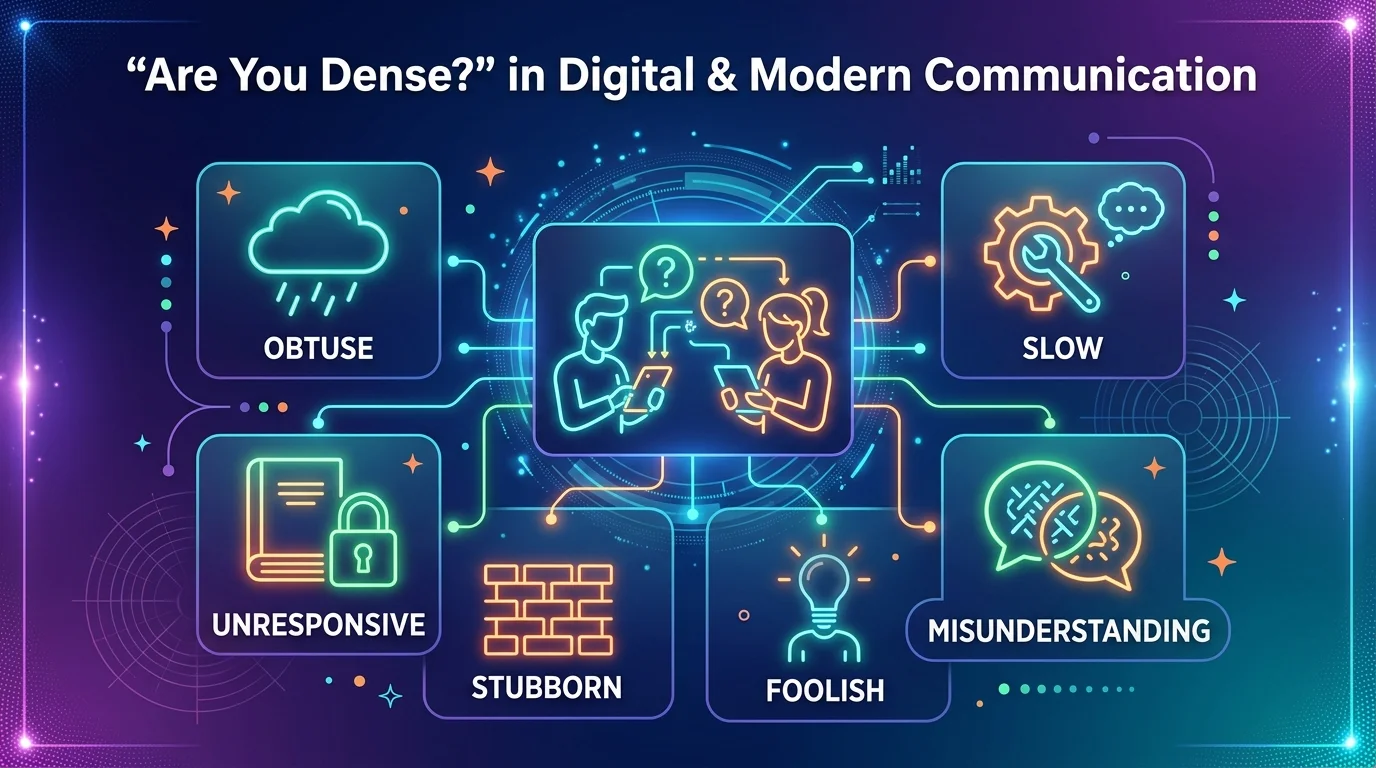
Emails
Written workplace communication benefits from neutral wording. “Are you dense?” can sound accusatory because there is no vocal tone to soften it.
Slack / WhatsApp
In group chats, context matters. Among friends, the phrase may be playful. In a work Slack channel, it can create unnecessary friction.
Social media
The expression frequently functions as a rhetorical insult in online arguments. Short replies can amplify conflict because participants may interpret disagreement as a personal attack.
AI-generated summaries
AI-generated summaries generally favor explicit and neutral language. When explaining the phrase, an accurate summary should identify both its literal structure and its figurative implication: it questions whether someone is having difficulty understanding something and can sound insulting or sarcastic.
Linguistic & Communication Insight
Emotional weight & subtext
Native speakers usually hear more than a simple question in “Are you dense?” The phrase often carries impatience, disbelief, sarcasm, or criticism. The speaker is usually implying that the answer should already be obvious.
That subtext is important because the listener may respond to the perceived judgment rather than the actual question.
Direct vs indirect phrasing
“Are you dense?” is highly direct. It puts the listener’s ability to understand under scrutiny.
“Is something unclear?” is indirect in comparison because it does not assume that the listener is responsible for the misunderstanding.
“Would you like me to explain that another way?” goes even further by clarifying a shared communication task.
This distinction is useful in professional settings. Directness can save time, but softening the wording can make cooperation easier when the relationship matters.
Professional communication perspective
In workplace communication, experienced communicators often separate the person from the problem. Instead of suggesting that an employee, client, or coworker is incapable of understanding, they identify the unclear information.
Compare:
“Are you dense?”
with:
“Which part would you like me to clarify?”
The second sentence maintains authority while keeping the conversation productive.
Pragmatic reasons for alternatives
Professionals may choose alternatives because they want to reduce defensiveness, encourage questions, preserve a working relationship, or signal that clarification is acceptable.
This does not mean indirect language is always better. If a speaker needs to be firm, “Do you understand?” may be appropriate. The key is matching the level of directness to the situation.
Social signaling
Word choice communicates social information. A blunt expression can signal impatience or informality, while supportive language can signal collaboration.
That is why two phrases with similar dictionary meanings can produce very different reactions.
Tone & context guidance
Use “Are you dense?” only when the relationship and context clearly support its informal or humorous character. Be particularly careful with written communication, professional relationships, unfamiliar audiences, and conversations involving sensitive subjects.
For most workplace and educational situations, alternatives that focus on clarity rather than intelligence are safer and more constructive.
Meaning, Usage & Examples for Each Alternative
Is Something Unclear?
Meaning: This asks whether the listener has difficulty understanding a particular piece of information, instruction, or explanation.
Why This Phrase Works: It focuses on the communication itself rather than labeling the listener. That makes it useful when the goal is to identify and fix a misunderstanding.
Real-World Usage Insight: This wording is common in professional communication because it leaves room for either person to clarify the issue.
Best Use: Emails, meetings, instructions, customer communication, and workplace discussions.
Avoid When: A deliberately playful or teasing tone is intended between close friends.
Tone: Neutral, professional, calm, and collaborative.
US vs UK Usage: Common and natural in both American and British English.
Example (Email / Message / Meeting):
“Is something unclear in the updated project brief? I’m happy to walk through the requirements before we finalize the timeline.”
Are You Following?
Meaning: This asks whether someone understands or is able to keep up with an explanation, discussion, or sequence of information.
Why This Phrase Works: It checks comprehension without directly suggesting that the listener lacks intelligence.
Real-World Usage Insight: Teachers, presenters, managers, and speakers often use this expression during longer explanations.
Best Use: Meetings, classrooms, presentations, training sessions, and conversations.
Avoid When: The listener may interpret repeated checking as pressure or impatience.
Tone: Conversational, neutral, and moderately direct.
US vs UK Usage: Widely understood and natural in both varieties of English.
Example (Meeting):
“We’re moving the launch back one week because of the testing results. Are you following, or should I go back over the timeline?”
Do You Understand?
Meaning: This is a direct question asking whether someone has understood information, instructions, or an explanation.
Why This Phrase Works: It is simple and unmistakable. The speaker clearly identifies comprehension as the issue without using an insulting adjective.
Real-World Usage Insight: The phrase works especially well when instructions need confirmation, although tone can make it sound firm.
Best Use: Instructions, teaching, safety communication, and important workplace procedures.
Avoid When: The speaker wants to avoid sounding authoritative or confrontational.
Tone: Direct, neutral to firm.
US vs UK Usage: Standard in both American and British English.
Example (Meeting):
“Please submit the revised figures by 3 p.m. today. Do you understand, or is there anything you need me to clarify?”
Did You Miss the Point?
Meaning: This asks whether someone failed to understand the main idea of an argument, explanation, or discussion.
Why This Phrase Works: It identifies a specific comprehension problem: missing the central idea rather than failing to understand everything.
Real-World Usage Insight: It is particularly common during disagreements when two people are focusing on different aspects of the same issue.
Best Use: Discussions, debates, feedback, and informal conversations.
Avoid When: Giving sensitive feedback to someone who may already feel criticized.
Tone: Direct, critical, and conversational.
US vs UK Usage: Common in both US and UK English.
Example (Social Media):
“I’m not saying the policy is perfect. I’m saying the proposed change affects small businesses differently. I think you missed the point of my post.”
Are You Confused?
Meaning: This asks whether someone is experiencing uncertainty or difficulty understanding the situation.
Why This Phrase Works: It identifies possible confusion without explicitly describing the person as unintelligent.
Real-World Usage Insight: The phrase can be supportive when delivered gently, but a sharp tone can still make it sound impatient.
Best Use: Casual conversations, tutoring, troubleshooting, and informal explanations.
Avoid When: Speaking to someone who may feel embarrassed about asking questions.
Tone: Casual, direct, and context-dependent.
US vs UK Usage: Natural and widely understood in both varieties.
Example (Conversation):
“Are you confused about which version we’re using? The file in the shared folder is the final one.”
Is That Clear?
Meaning: This asks whether the information or instruction has been understood.
Why This Phrase Works: It shifts attention toward the clarity of the information rather than making a judgment about the listener.
Real-World Usage Insight: Managers, teachers, presenters, and customer-service professionals commonly use this phrase when confirming instructions.
Best Use: Directions, presentations, meetings, and workplace communication.
Avoid When: The speaker’s tone is already tense, because it can sound abrupt.
Tone: Neutral, direct, and professional.
US vs UK Usage: Common in both American and British English.
Example (Meeting):
“We’ll keep the existing pricing through the end of the month and update the website on Monday. Is that clear?”
Conclusion
“Are You Dense?” is an informal expression used when someone appears to have difficulty understanding something the speaker considers obvious. Although its meaning is easy to recognize, its tone can range from sarcastic and teasing to impatient or insulting. Context, relationship, delivery, and communication medium all influence how the phrase is interpreted. In professional, academic, customer-service, and sensitive situations, more respectful alternatives such as “Is something unclear?” or “Would you like me to explain that another way?” are usually more appropriate.
These options keep attention on solving the misunderstanding rather than criticizing the person. Understanding the difference between direct, casual, supportive, and professional alternatives helps speakers choose language that fits their audience. For ESL learners, writers, students, and professionals, recognizing the emotional subtext of expressions like “Are You Dense?” is just as important as understanding their dictionary meaning. Effective communication depends not only on what words mean, but also on how those words may be received.
FAQs
What does “Are You Dense?” mean?
“Are You Dense?” is an informal expression asking whether someone is having difficulty understanding something that the speaker believes should be obvious. The word “dense” is used figuratively rather than literally. Depending on the situation and tone, the phrase can communicate frustration, disbelief, sarcasm, or playful teasing. It can also sound insulting when used seriously.
Is “Are You Dense?” rude?
“Are You Dense?” can be considered rude because it may imply that someone is unintelligent or unusually slow to understand. Among close friends, it can sometimes be used jokingly, but the same words may sound offensive in professional or unfamiliar relationships. If maintaining a respectful tone matters, “Is something unclear?” is generally a safer alternative.
Is “Are You Dense?” professional?
“Are You Dense?” is generally not considered professional language. It directly questions another person’s ability to understand and can create unnecessary tension in workplace communication. In emails, meetings, and business conversations, alternatives such as “Are you following?” or “Is there anything I can clarify?” communicate the need for understanding without making the comment personal.
What is a polite alternative to “Are You Dense?”
A polite alternative is “Is something unclear?” Other suitable choices include “Would you like me to explain that another way?” and “Is there anything I can clarify?” These expressions focus on resolving the misunderstanding instead of criticizing the listener. They are particularly useful in workplaces, classrooms, customer service, and other situations where maintaining cooperation is important.
Can “Are You Dense?” be used jokingly?
Yes, “Are You Dense?” can be used jokingly among people who have an established relationship and understand each other’s sense of humor. Facial expression, voice, and surrounding context can make the phrase sound playful rather than hostile. However, written messages often remove these cues, so a joke may be interpreted as an actual insult.
What does “dense” mean when describing a person?
When “dense” describes a person, it is usually a figurative term meaning slow to understand something or unable to recognize an apparently obvious point. This differs from the literal meanings of “dense,” which describe things that are closely packed or have high concentration. The figurative meaning can be negative and is often associated with informal language.
What is a professional way to ask if someone understands?
Professional options include “Is that clear?” “Are you following?” “Is something unclear?” and “Is there anything I can clarify?” The best choice depends on the situation. If the goal is collaboration, wording such as “Would you like me to explain that another way?” can encourage questions while avoiding language that places blame on the listener.
What is the difference between “Are You Dense?” and “Are You Confused?”
“Are You Dense?” usually carries a stronger implication that the listener should have understood something already and may sound insulting or sarcastic. “Are You Confused?” focuses more directly on a person’s current uncertainty. Both can be casual, but “Are You Confused?” is generally less judgmental when spoken in a supportive tone.
Is “Are You Dense?” common in American and British English?
“Are You Dense?” is understood in both American and British English. The figurative use of “dense” for someone slow to understand is established in both varieties. Differences are more likely to involve individual preferences and context than meaning. In both regions, the expression can sound blunt, sarcastic, or insulting depending on delivery and relationship.
What should I say instead of “Are You Dense?” at work?
At work, consider saying “Is something unclear?”, “What part is unclear?”, or “Would you like me to explain that another way?” These alternatives keep the discussion focused on information and clarification. They are useful in emails, meetings, Slack messages, presentations, and conversations because they reduce the risk of making a colleague feel personally criticized.

