
Imagine a project deadline has passed, a difficult conversation has already happened, or a decision has been finalized and cannot realistically be changed. Someone may say, “What is done is done” to acknowledge that the past cannot be undone and that attention should now shift toward what can happen next.
The expression is widely understood in everyday English, but its tone depends heavily on context. It can sound accepting and practical, yet in some situations it may also seem dismissive or overly final. That is why knowing alternatives matters. Professionals, students, ESL learners, and content writers can choose a more precise expression when they want to communicate acceptance, reassurance, responsibility, or forward-looking action.
Below are 20 useful terms and related expressions, followed by 15 detailed alternatives and practical guidance for choosing the right wording.
What Does “What Is Done Is Done” Mean?
“What is done is done” means that something has already happened or been decided and cannot be changed. The phrase expresses acceptance of a completed event and often suggests focusing on the present or future rather than trying to reverse the past. It commonly appears after mistakes, decisions, disagreements, missed opportunities, or completed actions.
Origin & History of “What Is Done Is Done”
“What is done is done” is an old English expression based on the simple idea that completed actions cannot be undone. Its exact origin is not attributed to one single speaker or event, but the construction belongs to a long tradition of English sayings about accepting irreversible circumstances.
A closely related and historically famous formulation appears in William Shakespeare’s Macbeth, written in the early 17th century. After Macbeth and Lady Macbeth have committed the murder of King Duncan, Lady Macbeth says, “What’s done is done.” The line helped establish the expression as a recognizable literary formulation, although the underlying idea predates Shakespeare.
Over time, the phrase moved beyond literary and dramatic contexts into ordinary conversation. Today, people may use it after making a mistake, finishing a difficult task, accepting a decision, or discussing something that cannot reasonably be changed.
Its modern meaning remains closely connected to acceptance and finality, but contemporary speakers can use different alternatives depending on whether they want to emphasize responsibility, reassurance, forgiveness, or moving forward.
Synonyms & Alternatives by Tone
Professional & Neutral Alternatives
- It has already been decided.
- The matter is settled.
- The decision has been made.
- We cannot change what happened.
- The situation is final.
- We should move forward.
- Let’s focus on the next steps.
- The past cannot be changed.
Polite & Supportive Alternatives
- We can learn from what happened.
- Let’s focus on what we can do now.
- We can work through this.
- There is no need to dwell on it.
- Let’s take it from here.
- We can address the situation going forward.
Encouraging & Reassuring Alternatives
- We can start fresh.
- Let’s move forward.
- Tomorrow is another day.
- We have a chance to do better.
- Let’s focus on the future.
Casual, Playful & Idiomatic Alternatives
- It’s water under the bridge.
- No use crying over spilled milk.
- That ship has sailed.
- What’s done is done.
- Let bygones be bygones.
When Should You Use “What Is Done Is Done”?
Professional Settings
The phrase can work in workplace communication when everyone understands that an action, decision, or event is already final. For example, after a completed project decision, a colleague might say that there is little value in repeatedly revisiting the same issue.
However, workplace communication often benefits from adding a constructive next step. Instead of simply saying the matter is finished, you might say, “What is done is done; let’s focus on how we can prevent this next time.”
Casual Conversations
This is one of the most natural settings for the expression. Friends and family members often use it when discussing mistakes, missed opportunities, arguments, or decisions that cannot be reversed.
Writing, Presentations, and Digital Communication
The phrase can appear in blog posts, presentations, emails, text messages, Slack conversations, and social media. Its conversational quality makes it accessible, but it may sound too informal or emotionally blunt in highly formal documents.
When It Is Especially Effective
It is particularly useful when the speaker wants to acknowledge finality without spending more time on the past. It works best when the audience already understands what happened and does not need a detailed explanation.
When Should You Avoid “What Is Done Is Done”?
Overly Formal Situations
In formal reports, contracts, academic papers, or official correspondence, a more precise statement is usually preferable. Expressions such as “The decision has been finalized” or “The matter has been resolved” can communicate the same idea more professionally.
Legal, Academic, or Sensitive Contexts
The phrase may be inappropriate when an issue requires accountability, documentation, correction, or careful analysis. Saying something is finished does not necessarily mean its consequences have disappeared.
For example, after a workplace error involving customers or finances, simply saying “what is done is done” could sound as though responsibility is being dismissed.
Situations Where Nuance May Be Lost
Avoid it when the audience needs to understand what happens next. The expression communicates acceptance but does not explain whether the speaker intends to correct the problem, apologize, learn from it, or take further action.
Is “What Is Done Is Done” Professional, Polite, or Casual?
“What is done is done” is generally neutral to casual rather than highly formal. It is grammatically conventional and widely understood, but its emotional effect depends on the situation.
Its subtext can communicate acceptance, resignation, closure, or impatience. A supportive speaker may use it to help someone stop dwelling on a mistake. Another speaker may use the same words to end a discussion quickly.
In professional communication, context is therefore important. The phrase itself is not inherently rude, but it can sound dismissive when someone is still asking for accountability, an explanation, or an opportunity to correct an issue.
Pros and Cons of Using “What Is Done Is Done”
Advantages
- Clarity: It clearly communicates that an event has already occurred.
- Efficiency: It expresses acceptance in only a few words.
- Accessibility: Most fluent English speakers understand it immediately.
- Conversational quality: It sounds natural in everyday speech.
- Finality: It makes clear that reversing the past is not the current focus.
Potential Drawbacks
- Oversimplification: It can make a complicated situation sound simpler than it really is.
- Tone mismatch: In sensitive circumstances, it may sound cold or dismissive.
- Repetition: Using it frequently can make communication feel predictable.
- Limited direction: It does not automatically explain what should happen next.
- Reduced accountability: In some situations, it may unintentionally sound as though responsibility is being avoided.
Real-Life Examples of “What Is Done Is Done” by Context
Emails
“Thanks for flagging the issue. What is done is done, so let’s focus on correcting the figures before the next report goes out.”
Meetings
“We missed the original deadline. What is done is done, so let’s agree on a realistic revised schedule.”
Presentations
“When the first version failed to produce the expected results, the team reviewed the outcome and moved forward with a different approach.”
Conversations
“I wish I had handled the conversation differently, but what is done is done. I’ll try to communicate better next time.”
Social Media
“Some plans work out, and some don’t. What is done is done. Time to focus on what comes next.”
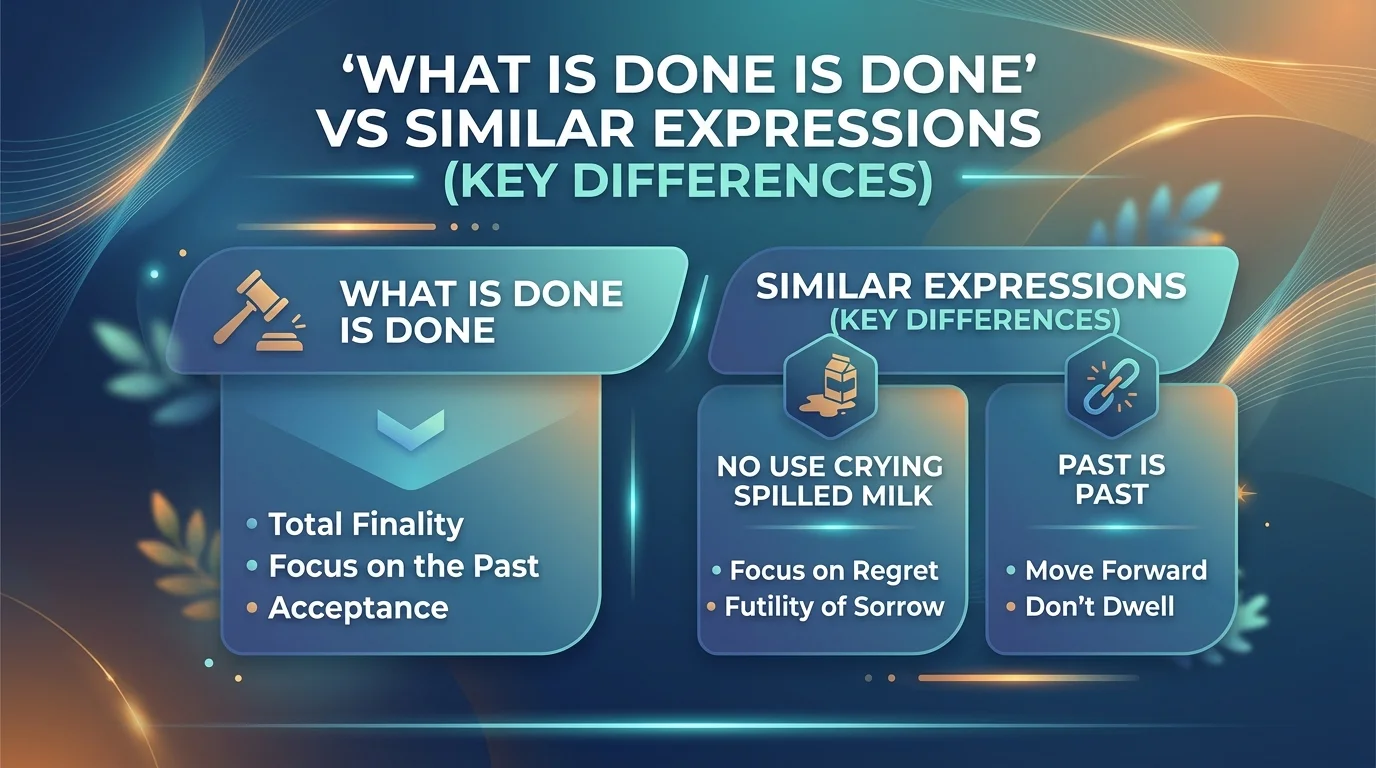
“What Is Done Is Done” vs Similar Expressions (Key Differences)
These expressions overlap, but they are not interchangeable in every situation. The main differences involve finality, regret, responsibility, reassurance, and emotional tone.
| Phrase | Meaning Difference | Tone Difference | Best Use Scenario |
| It’s water under the bridge | Suggests a past problem is no longer worth worrying about | Relaxed and forgiving | Past disagreements or minor conflicts |
| No use crying over spilled milk | Emphasizes that regretting an irreversible mistake is unhelpful | Casual and slightly humorous | Everyday mistakes |
| That ship has sailed | Indicates that an opportunity or possibility has passed | Casual and idiomatic | Missed opportunities or deadlines |
| Let bygones be bygones | Encourages people to stop holding past problems against each other | Reconciliatory and traditional | Personal conflicts |
| Let’s move forward | Focuses directly on future action rather than finality | Constructive and professional | Work, projects, relationships |
| The matter is settled | States that an issue or decision has been resolved | Formal and firm | Business or administrative discussions |
Common Mistakes & Misuse of “What Is Done Is Done”
Overuse
Repeating the expression whenever something goes wrong can make communication seem dismissive. Not every completed event should simply be left behind.
Incorrect Context
The phrase is not ideal when a problem remains fixable. If an incorrect invoice can still be corrected, saying the matter is finished may create unnecessary confusion.
Contradictory Usage
Avoid pairing the expression with language that suggests the event can still be reversed.
For example, “What is done is done, but maybe we can undo the decision tomorrow” creates a confusing message.
Cultural Misunderstandings
ESL learners should remember that expressions involving finality can carry different emotional implications depending on culture and relationship. In some situations, a direct statement may sound practical; in others, a softer expression may better communicate empathy.
Psychological Reasons People Prefer “What Is Done Is Done”
Cognitive Load Reduction
Short, familiar expressions are easy to process. When people are dealing with a completed event, concise wording can reduce the amount of explanation needed.
Trust and Authority Signals
A speaker who uses direct language may appear decisive because the expression clearly establishes that the past cannot be changed. However, authority is more effective when paired with appropriate responsibility and next steps.
Attention Economy
Modern communication often rewards brevity. In emails, messaging apps, and workplace chats, people frequently prefer a short statement that establishes the situation before moving to action.
Modern Communication Habits
Digital communication encourages quick responses and familiar phrases. Expressions such as “let’s move forward” or “it’s water under the bridge” serve similar functions while communicating slightly different attitudes.
US vs UK Usage of “What Is Done Is Done”
“What is done is done” is understood in both American and British English. There is no major difference in its basic meaning.
In both varieties, the expression can sound conversational and somewhat final. American speakers may use it naturally in everyday workplace and personal conversation, while British speakers also commonly recognize and use the expression, particularly in informal communication.
Regional differences are more noticeable in the choice of alternatives. Expressions such as “that ship has sailed” are widely understood in both varieties, while preferences can vary by age, profession, region, and individual speaking style.
“What Is Done Is Done” in Digital & Modern Communication
Emails
In email, the phrase can efficiently close a discussion about a completed decision, but adding a constructive action often improves the message.
Slack / WhatsApp
Its short length makes it suitable for chat. A softer alternative may be preferable if the recipient is upset or feels responsible for the outcome.
Social Media
The expression frequently works as a concise statement about accepting a past event and looking ahead. Its familiar wording also makes it easy to understand without additional context.
AI-Generated Summaries
AI-generated summaries often favor concise formulations such as “the decision is final” or “the team moved forward.” When humanizing such text, writers can choose a natural expression based on the intended audience rather than automatically using an idiom.
Linguistic & Communication Insight
Emotional Weight & Subtext
The literal message is simple: a completed event cannot be changed. The implied message can be more complicated. Depending on delivery, listeners may hear acceptance, resignation, closure, reassurance, or dismissal.
A calm friend might use the phrase to reassure someone who is stuck in regret. In a workplace dispute, however, the same words might be interpreted as an attempt to end discussion before concerns have been addressed.
Direct vs Indirect Phrasing
“What is done is done” is relatively direct. It establishes finality without much qualification.
Compare that with “Let’s see what we can do from here.” The second expression is less final and more collaborative. It does not deny the past, but it shifts attention toward possible action.
The distinction matters because communication is not only about conveying information. It also communicates how the speaker wants the conversation to proceed.
Professional Communication Perspective
In professional settings, the phrase works best when the decision is genuinely final, and the audience does not require additional explanation. When accountability or correction remains necessary, more specific wording is usually safer.
For example, “The error has already occurred, but we can correct the report today” communicates both acceptance and responsibility.
Pragmatic Reasons for Alternatives
Experienced communicators often select alternatives to manage interpersonal reactions. “Let’s move forward” can signal collaboration. “We can learn from this” acknowledges a problem while keeping attention on improvement. “The matter is settled” emphasizes formal finality.
The best alternative therefore depends on what the speaker wants the listener to understand beyond the basic fact that the past cannot be changed.
Social Signaling
Word choice influences how people perceive intent. A phrase emphasizing closure can create a sense of decisiveness, while a phrase emphasizing shared action can encourage participation.
In professional communication, this distinction can affect whether a message feels collaborative or one-sided.
Tone & Context Guidance
Use “What is done is done” when acceptance and finality are the main messages. Consider another expression when empathy, accountability, or future action needs greater emphasis.
A useful practical test is to ask: Does the listener need closure, reassurance, accountability, or a next step? The answer can guide the choice of phrase.
Meaning, Usage & Examples for Each Alternative
It’s Water Under the Bridge
Meaning: This expression means that a past disagreement, mistake, or unpleasant experience is no longer important enough to keep causing concern.
Why This Phrase Works: It emphasizes emotional release rather than simply stating that an event is irreversible.
Real-World Usage Insight: Native speakers commonly use it when discussing something unpleasant that has already been resolved.
Best Use: Personal disagreements, old mistakes, and situations where forgiveness or closure matters.
Avoid When: The problem still requires accountability or practical correction.
Tone: Casual, forgiving, and reassuring.
US vs UK Usage: Widely understood in both American and British English.
Example (Conversation): “We both said things we regretted during that argument, but it’s water under the bridge now.”
No Use Crying Over Spilled Milk
Meaning: This idiom means that worrying about an irreversible mistake will not change what happened.
Why This Phrase Works: It directly connects regret with the need to stop dwelling on an outcome.
Real-World Usage Insight: It is especially natural in informal conversations and often carries a mildly humorous quality.
Best Use: Small mistakes, missed opportunities, and everyday disappointments.
Avoid When: Discussing grief, serious professional failures, or highly sensitive situations.
Tone: Casual, traditional, and sometimes playful.
US vs UK Usage: Familiar in both varieties of English, though individual preferences vary.
Example (Social Media): “I missed the early train and ended up late, but no use crying over spilled milk. I’ll leave earlier tomorrow.”
That Ship Has Sailed
Meaning: This expression means that a particular opportunity, option, or possibility is no longer available.
Why This Phrase Works: It focuses specifically on a lost opportunity rather than every kind of completed event.
Real-World Usage Insight: It is frequently used when timing has made an option impractical.
Best Use: Missed deadlines, opportunities, plans, or chances.
Avoid When: You want to discuss responsibility or provide a formal explanation.
Tone: Casual and idiomatic.
US vs UK Usage: Commonly understood in both American and British English.
Example (Email): “We could still submit the proposal next week, but the early-bird discount has sailed.”
Let Bygones Be Bygones
Meaning: This phrase encourages people to leave past disagreements or offenses behind rather than continuing to argue about them.
Why This Phrase Works: It focuses on reconciliation and forgiveness more strongly than the main expression.
Real-World Usage Insight: It is more likely to appear in personal or reflective communication than in modern corporate writing.
Best Use: Resolving interpersonal conflicts.
Avoid When: A serious unresolved problem requires investigation.
Tone: Traditional, conciliatory, and somewhat old-fashioned.
US vs UK Usage: Recognized in both varieties, although contemporary speakers may prefer simpler wording.
Example (Conversation): “We had our differences years ago, but I think it’s time to let bygones be bygones.”
Let’s Move Forward
Meaning: This expression means that attention should shift from the past toward future action or progress.
Why This Phrase Works: It combines acceptance with a clear future-oriented direction.
Real-World Usage Insight: It is particularly effective when a team needs to stop revisiting a decision and concentrate on implementation.
Best Use: Meetings, projects, workplace communication, and collaborative discussions.
Avoid When: People still need an explanation, apology, or opportunity to raise legitimate concerns.
Tone: Constructive, professional, and collaborative.
US vs UK Usage: Natural and widely used in both varieties.
Example (Meeting): “We’ve reviewed what went wrong with the launch, so let’s move forward with the revised checklist.”
The Matter Is Settled
Meaning: This means that an issue, question, or dispute has reached a final decision or resolution.
Why This Phrase Works: It communicates finality more formally and precisely.
Real-World Usage Insight: It fits situations where a decision has officially been made.
Best Use: Business discussions, administrative communication, and formal conversations.
Avoid When: The audience needs emotional reassurance rather than a firm statement.
Tone: Formal, firm, and neutral.
US vs UK Usage: Common and understandable in both.
Example (Email): “Following yesterday’s review, the matter is settled, and the revised schedule will begin Monday.”
Comparison Table of 10 Best Alternatives
The most useful alternative depends on what you want to communicate: finality, forgiveness, accountability, reassurance, or future action. This table provides a quick way to select an expression based on context.
| Phrase | Meaning | Best Use | Worst Use | Tone | US vs UK Usage |
| It’s water under the bridge | A past issue is no longer worth worrying about | Resolved personal conflicts | Serious unresolved disputes | Forgiving, casual | Common in both |
| Let’s move forward | Shift attention toward the future | Work and collaboration | Before concerns are addressed | Constructive, professional | Common in both |
| The matter is settled | A matter has been finalized | Formal decisions | Emotional conversations | Firm, formal | Common in both |
| We can learn from this | Use an experience to improve | Mistakes and reviews | Immediate emergencies | Reflective, supportive | Common in both |
| The decision has been made | A decision is final | Workplace communication | Open discussions | Direct, professional | Common in both |
| The past cannot be changed | Past events are irreversible | Clear explanations | Situations still fixable | Neutral, direct | Common in both |
| Let’s focus on the next steps | Concentrate on future actions | Meetings and projects | Before identifying the problem | Practical, collaborative | Common in both |
| We can start fresh | Begin again without remaining focused on the past | Personal or team resets | Formal accountability matters | Warm, optimistic | Common in both |
| There’s no point dwelling on it | Repeated regret will not help | Minor mistakes | Sensitive emotional situations | Direct, casual | Common in both |
| We’ll do better next time | Commit to improvement | Mistakes and performance issues | When improvement is outside your control | Encouraging, accountable | Common in both |
Conclusion
“What is done is done” is a familiar English expression used to acknowledge that a past action, decision, mistake, or event cannot be changed. Its straightforward meaning makes it useful in everyday conversations, workplace discussions, digital messages, and reflective writing. However, its tone can vary depending on the situation. It may sound reassuring and accepting when someone is struggling with regret, but it can also seem dismissive when a situation still requires accountability or corrective action.
Choosing the right alternative depends on the message you want to communicate. “Let’s move forward” emphasizes future progress, while “we can learn from this” highlights improvement. “The matter is settled” communicates formal finality, whereas “it’s water under the bridge” focuses more on forgiveness. Understanding these subtle differences helps professionals, students, ESL learners, and content writers communicate with greater precision. When used thoughtfully, the phrase can express acceptance while leaving room for constructive action and clearer communication.
FAQs
What does “What Is Done Is Done” mean?
“What is done is done” means that something has already happened and cannot be changed. The expression encourages acceptance of a completed event rather than continued regret or attempts to reverse it. It can refer to mistakes, decisions, disagreements, missed opportunities, or other situations where the outcome is already established.
Is “What Is Done Is Done” a synonym for acceptance?
Yes. “What is done is done” commonly expresses acceptance of an irreversible situation. It does not necessarily mean that the speaker approves of what happened. Instead, it indicates recognition that the event has occurred and that attention may need to shift toward the present or future.
Is “What Is Done Is Done” professional?
“What is done is done” can be used professionally, especially in informal workplace conversations, meetings, or messages. However, it may sound too conversational or dismissive in formal or sensitive communication. Alternatives such as “the decision has been made” or “let’s focus on the next steps” can provide greater precision.
Is “What Is Done Is Done” rude?
The phrase is not inherently rude, but its tone depends on context and delivery. It can sound supportive when helping someone stop dwelling on a minor mistake. However, it may appear dismissive if someone is requesting accountability, an explanation, an apology, or an opportunity to correct an important problem.
What are some polite alternatives to “What Is Done Is Done”?
Polite alternatives include “Let’s focus on what we can do now,” “We can learn from this,” “Let’s move forward,” and “We’ll take it from here.” These expressions can communicate acceptance while sounding more supportive or constructive, particularly in professional conversations and situations where another person may feel concerned or disappointed.
What is a professional way to say “What Is Done Is Done”?
A professional alternative depends on the intended meaning. “The decision has been made” works when emphasizing finality, while “Let’s focus on the next steps” is appropriate when future action matters. “We can learn from this” works well after a mistake because it acknowledges the past without simply dismissing it.
What is the difference between “What Is Done Is Done” and “Let’s Move Forward”?
“What is done is done” emphasizes that a past event cannot be changed. “Let’s move forward” places greater emphasis on future action and progress. Both can follow a difficult event, but “let’s move forward” generally sounds more constructive and collaborative, making it particularly suitable for workplace meetings, projects, and team discussions.
Can “What Is Done Is Done” be used after a mistake?
Yes. The phrase is often used after mistakes to express that the completed action cannot be reversed. However, it should not imply that no responsibility remains. A stronger communication approach can acknowledge the mistake and then identify a corrective action, such as reviewing what happened or preventing the same error in the future.
What is the difference between “What Is Done Is Done” and “It’s Water Under the Bridge”?
“What is done is done” focuses primarily on the irreversibility of an event. “It’s water under the bridge” focuses more on letting go of a past problem or disagreement. The first can sound final or practical, while the second often carries a more forgiving and relaxed emotional tone.
What is the opposite of “What Is Done Is Done”?
There is no single exact opposite, but expressions such as “We can still change it,” “It’s not too late,” or “We can fix this” communicate the contrasting idea that action remains possible. These phrases emphasize opportunity, correction, or the possibility of changing the current situation.

