
Imagine someone keeps making sarcastic comments during a stressful meeting, and you can feel the conversation becoming more heated. You may respond, “Don’t provoke me.” The message is clear: stop doing or saying things that are deliberately or repeatedly making me angry or encouraging a stronger reaction.
“Don’t provoke me” is a direct warning that asks another person to stop behavior that is causing irritation, anger, or emotional pressure. It can be useful when someone needs to establish a boundary quickly, but its effect depends heavily on tone, relationship, and context.
In everyday English, the phrase can sound serious, confrontational, or even playful depending on how it is delivered. In professional communication, a softer alternative may communicate the same boundary without making the other person defensive. Knowing expressions such as “Please don’t push me,” “Let’s keep this constructive,” or “I’d appreciate it if you stopped” helps speakers choose language that matches the situation.
What Does “Don’t Provoke Me” Mean?
“Don’t provoke me” means “do not deliberately or repeatedly do something that makes me angry or encourages me to react.” The phrase is commonly used when someone feels irritated, challenged, pressured, or intentionally tested. It can appear in arguments, personal conversations, workplace disagreements, online discussions, or playful exchanges, depending on tone and context.
Origin & History of “Don’t Provoke Me”
The key word provoke comes from the Latin provocare, meaning “to call forth,” “challenge,” or “call out.” It was formed from Latin elements associated with calling or bringing something forward. The word entered English through French and developed meanings connected with challenging, stimulating, or causing a particular reaction.
Historically, provoke did not always have a purely negative meaning. It could refer to causing something to happen, stimulating a response, or challenging someone. Over time, the word became strongly associated with deliberately causing anger or an emotional reaction, especially in expressions such as “provoke someone” and “provoke a reaction.”
The construction “Don’t provoke me” is an imperative sentence. It combines the negative command “don’t” with “provoke,” making the speaker’s intention immediate: stop the behavior that may cause a reaction.
Modern English speakers may use the phrase seriously during conflict, but popular culture has also made it familiar in joking, dramatic, and playful contexts. As a result, its interpretation now depends significantly on voice, facial expression, relationship, and surrounding words.
Synonyms & Alternatives by Tone
Professional & Neutral Alternatives
- Please don’t push me on this.
- I’d appreciate it if you stopped.
- Please respect my boundaries.
- Let’s keep this constructive.
- I’d rather not continue this discussion.
- Please don’t pressure me.
- Let’s not escalate the situation.
- I need you to stop.
- Please give me some space.
- Let’s take a step back.
Polite & Supportive Alternatives
- I’d appreciate some space.
- Please give me a moment.
- I’d prefer not to continue right now.
- Let’s pause for a moment.
- I’m not comfortable with this.
- Could we approach this differently?
- I’d rather keep things calm.
- Could we talk about this later?
Encouraging & Reassuring Alternatives
- Let’s work through this calmly.
- We can discuss this without escalating things.
- Let’s take a breath and start again.
- I’m willing to talk if we can keep it respectful.
- Let’s focus on solving the problem.
- We can find a better way to handle this.
Casual, Playful & Idiomatic Alternatives
- Don’t push your luck.
- Don’t push me.
- Back off.
- Give me a break.
- Don’t test me.
- You’re pushing it.
- Quit messing with me.
- Don’t get on my nerves.
- Leave it alone.
- Give it a rest.
When Should You Use “Don’t Provoke Me”?
“Don’t provoke me” works best when you need to communicate a clear boundary or warning without giving a long explanation. It is particularly effective when the other person already understands what behavior is causing the problem.
Professional Settings
The phrase can be understood in the workplace, but it is usually better reserved for situations where a firm personal boundary needs to be established. A calmer option such as “Please don’t push this further” may be more appropriate in front of colleagues or clients.
Casual Conversations
Among friends, relatives, or familiar acquaintances, “Don’t provoke me” can be natural when someone is deliberately teasing or annoying you. Depending on facial expression and voice, it may communicate genuine irritation or playful resistance.
Writing, Presentations, and Digital Communication
Written communication removes vocal cues, so the phrase can appear harsher on screen than it would sound in person. In emails and workplace messages, consider adding context or using a less confrontational alternative.
When It Is Especially Effective
The expression is most effective when the listener understands the boundary and the speaker genuinely needs the behavior to stop. It is less effective when the goal is persuasion, collaboration, or conflict resolution.
When Should You Avoid “Don’t Provoke Me”?
Avoid the phrase when the situation requires especially careful, neutral, or formal language.
In legal or official communication, describing the specific behavior is usually clearer than saying someone is provoking you. For example, “Please stop contacting me about this matter” communicates a more precise boundary.
In academic writing, the phrase is generally too conversational unless it appears inside quoted speech or is being analyzed as language.
In sensitive workplace situations, it may unintentionally sound threatening or emotionally charged. A statement such as “I’d like to pause this conversation” can establish a boundary while leaving more room for cooperation.
The phrase can also cause problems when the speaker’s intention is unclear. Without vocal context, readers may interpret it as anger, intimidation, or hostility.
Is “Don’t Provoke Me” Professional, Polite, or Casual?
“Don’t provoke me” is generally direct and emotionally charged rather than highly professional or especially polite. It is grammatically standard and understandable, but its tone can range from firm to confrontational.
The emotional subtext often suggests that the speaker believes the listener is causing, encouraging, or deliberately increasing irritation. The phrase therefore places attention on the listener’s behavior rather than simply describing the speaker’s own feelings.
In professional environments, alternatives such as “Please don’t pressure me on this” or “Let’s keep the discussion constructive” often sound more collaborative.
Among friends, “Don’t provoke me” may be perfectly natural, particularly when accompanied by humor. In online communication, however, readers cannot hear the speaker’s voice, so the phrase may appear more aggressive than intended.
Pros and Cons of Using “Don’t Provoke Me”
Advantages
Clarity: The listener immediately understands that a particular behavior needs to stop.
Efficiency: The phrase communicates a boundary in only three words.
Accessibility: It uses familiar vocabulary that most English speakers understand.
Strong boundary-setting: It can be useful when indirect language has already failed.
Potential Drawbacks
Oversimplification: It does not explain exactly what behavior is causing the problem.
Tone mismatch: In professional situations, it may sound more confrontational than intended.
Repetition: Using the phrase repeatedly can make communication feel hostile or predictable.
Possible ambiguity: The listener may not know what action is considered provocative.
Real-Life Examples of “Don’t Provoke Me” by Context
A direct email might say:
“I’ve already explained my position on this issue, so please don’t provoke me into reopening the discussion.”
For workplace communication, however, a calmer version would usually be preferable:
“I’ve explained my position, and I’d prefer not to reopen the discussion.”
Meetings
During a tense meeting, someone might say:
“I’m happy to discuss the figures, but don’t provoke me by suggesting I changed the numbers.”
A more collaborative professional version would be:
“Let’s focus on the figures rather than assumptions about how they were prepared.”
Presentations
The phrase is uncommon in formal presentations because presentations generally aim for objective and audience-friendly language. If someone interrupts repeatedly, a speaker might instead say:
“Please let me finish the point, and I’ll take questions afterward.”
Conversations
A friend teasing someone about a sensitive subject might hear:
“Okay, don’t provoke me. You know I’m already annoyed.”
Here, the phrase can sound natural because the relationship provides context.
Social Media
In a heated online discussion, someone might write:
“I’ve answered this question several times. Don’t provoke me into turning this into an argument.”
Because written social media communication lacks vocal cues, a less confrontational alternative may prevent unnecessary escalation.
“Don’t Provoke Me” vs Similar Expressions
| Phrase | Meaning Difference | Tone Difference | Best Use Scenario |
| Don’t push me | Warns someone not to pressure or challenge you further. | Direct and firm. | Arguments, boundaries, difficult conversations. |
| Don’t test me | Suggests someone is testing your patience, limits, or resolve. | Strong and sometimes intimidating. | Personal conflict or dramatic situations. |
| Back off | Tells someone to stop interfering or move away from the situation. | Blunt and forceful. | Personal boundaries or escalating interactions. |
| Don’t push your luck | Warns someone that continued behavior may have negative consequences. | Casual, idiomatic, sometimes playful. | Teasing, negotiations, or informal disagreements. |
| Please give me some space. | Requests physical or emotional distance rather than directly accusing someone of provoking you. | Polite and controlled. | Sensitive conversations and personal situations. |
| Let’s take a step back | Suggests pausing or reducing tension rather than warning the other person. | Professional and collaborative. | Workplace discussions and conflict resolution. |
Common Mistakes & Misuse of “Don’t Provoke Me”
Overuse
Using the expression every time someone disagrees with you can weaken its impact. A disagreement is not necessarily provocation.
Incorrect Context
“Don’t provoke me” may be inappropriate when someone is simply asking a reasonable question. The word provoke implies that the other person’s behavior is causing or encouraging an emotional reaction.
Contradictory Usage
A speaker may say “Don’t provoke me” while continuing to insult or challenge the other person. This creates mixed signals because the speaker is asking for de-escalation while contributing to the conflict.
Cultural Misunderstandings
English learners should be aware that the phrase can sound stronger than a literal translation might suggest. In some contexts, native speakers may perceive it as a warning rather than a simple request.
Psychological Reason People Prefer “Don’t Provoke Me”
People often choose short expressions during emotionally charged situations because short language reduces the amount of information that needs to be processed and delivered.
“Don’t provoke me” identifies the speaker’s boundary quickly. It also signals that the speaker expects the listener to recognize a connection between their behavior and the speaker’s emotional response.
Cognitive Load Reduction
When people are frustrated, concise language can feel easier to produce than a detailed explanation. A three-word warning requires little preparation.
Trust and Authority Signals
A direct boundary can communicate certainty. However, authority and aggression are not the same thing. In professional environments, calm specificity often creates a stronger impression than an emotionally charged warning.
Attention Economy
Modern communication frequently happens through short messages, notifications, chats, and comments. Brief phrases can communicate an entire interpersonal position quickly.
Modern Communication Habits
Messaging platforms encourage compressed language. As a result, expressions such as “Don’t push me” and “Back off” are frequently used because they are immediately understandable without lengthy explanation.
US vs UK Usage of “Don’t Provoke Me”
“Don’t provoke me” is understood in both American and British English. There is no major difference in the basic meaning of the phrase.
In both varieties, the expression can sound serious when used during an argument and playful when used between people who have an established joking relationship.
American English frequently uses alternatives such as “Don’t push me,” “Don’t test me,” and “Back off.” British English also uses these expressions, while informal British speech may favor context-dependent expressions such as “Don’t push your luck” or “You’re pushing it.”
The difference is therefore more about conversational preference, individual style, and situation than a fundamental difference in meaning.
“Don’t Provoke Me” in Digital & Modern Communication
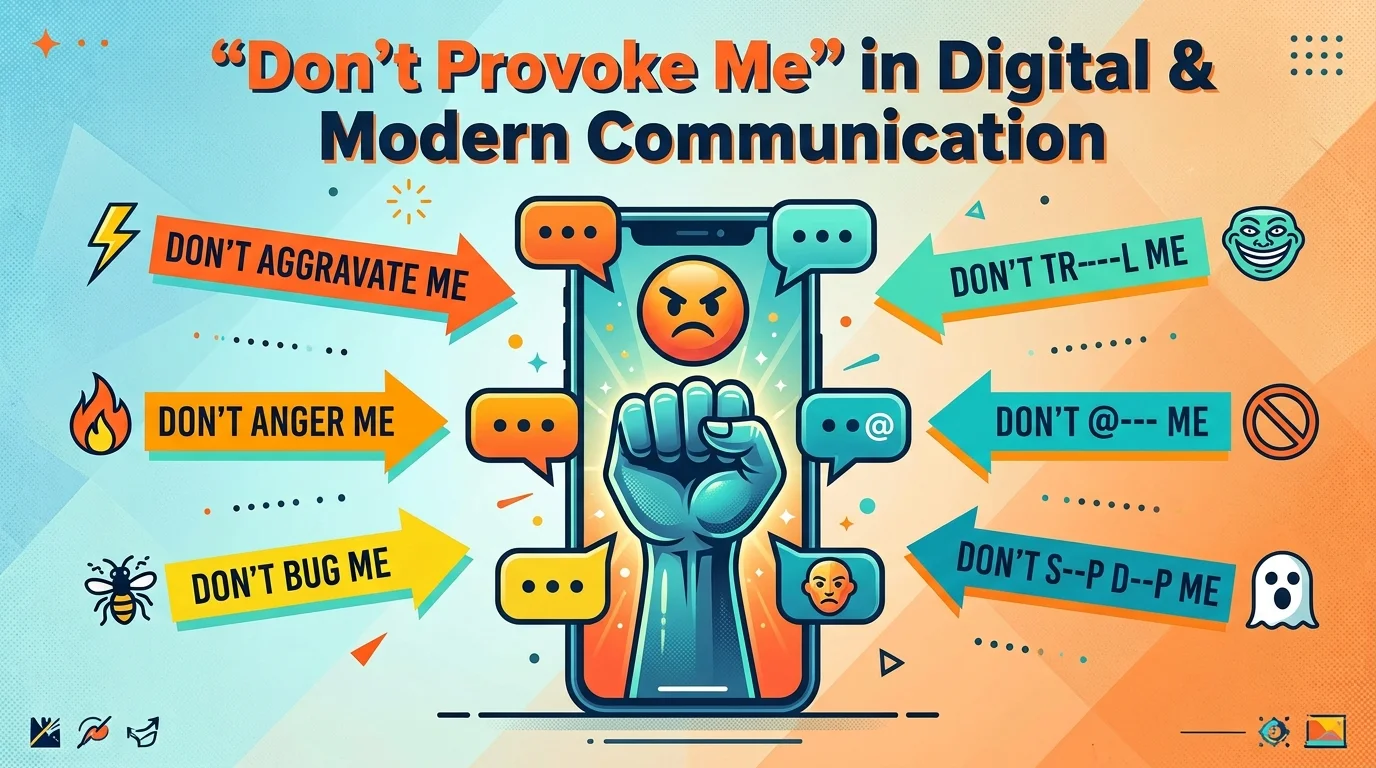
Emails
In professional emails, “Don’t provoke me” can appear unnecessarily confrontational. A more precise sentence often works better:
“I’d prefer that we keep the discussion focused on the original issue.”
Slack and WhatsApp
The phrase can be natural in informal team chats or personal conversations, but written tone can easily be misunderstood. Emojis, surrounding context, or a softer formulation may clarify whether the statement is serious or playful.
Social Media
On social platforms, “Don’t provoke me” can function as a boundary, warning, or dramatic response. However, because social media encourages public interaction, an aggressive-sounding response can invite further discussion instead of ending it.
AI-Generated Summaries
AI-generated summaries may simplify emotionally nuanced language. If “Don’t provoke me” appears in a conversation, a good summary should preserve the distinction between a request to stop irritating behavior and an explicit threat. The phrase itself does not necessarily indicate an intention to harm someone.
Linguistic & Communication Insight
Emotional Weight & Subtext
Native speakers generally understand “Don’t provoke me” as more than a neutral request. It often carries the subtext that the speaker feels irritated, challenged, or close to reacting.
The exact emotional weight depends on delivery. A smiling friend can use it jokingly, while the same words during an argument can function as a serious warning.
Direct vs Indirect Phrasing
“Don’t provoke me” is direct because it identifies the listener’s behavior as the source of the problem. A softer expression such as “I’d appreciate some space” focuses instead on the speaker’s need.
This distinction matters. Direct language can establish a boundary quickly, while indirect language can reduce defensiveness and leave more room for cooperation.
Professional Communication Perspective
In professional communication, the central question is often not whether the phrase is grammatically correct but whether its tone supports the communication goal.
If the goal is to stop inappropriate behavior immediately, a direct statement may be justified. If the goal is to resolve a disagreement, however, “Don’t provoke me” can shift attention from the issue to the emotional conflict.
Pragmatic Reasons for Alternatives
Experienced communicators often select alternatives because they want to maintain authority without creating unnecessary defensiveness.
For example:
“Let’s take a step back.”Frames the situation as a shared problem.
By contrast:
“Don’t provoke me.”
places responsibility for the emotional escalation more directly on the listener.
Social Signaling
Word choice affects how people interpret confidence, openness, authority, and hostility. A firm but specific boundary can communicate confidence without sounding threatening.
Compare:
“Don’t provoke me.”
with:
“I’m willing to discuss this, but I’d like us to keep the conversation respectful.”
The second version provides more information about the speaker’s expectations and leaves a path toward cooperation.
Tone & Context Guidance
Use “Don’t provoke me” when a firm warning is genuinely appropriate, and the relationship provides enough context for the listener to understand the intention.
Choose a softer alternative when you are dealing with customers, colleagues, students, unfamiliar people, sensitive topics, or written communication where tone can easily be misread.
Meaning, Usage & Examples for Each Alternative
Please Don’t Push Me
Meaning: This means asking someone not to pressure, challenge, or force you beyond a particular limit.
Why This Phrase Works: It preserves the boundary-setting function of “Don’t provoke me” while focusing on pressure rather than anger.
Real-World Usage Insight: This expression is useful when someone continues demanding an answer, decision, or action after you have already explained your position.
Best Use: Difficult conversations, negotiations, workplace disagreements, and personal boundaries.
Avoid When: You actually need to address deliberate insults or inappropriate behavior directly.
Tone: Firm, direct, and moderately conversational.
US vs UK Usage: Common and easily understood in both American and British English.
Example (Email / Message / Meeting): “I understand that you need an answer today, but please don’t push me into making a decision before I’ve reviewed the figures.”
I’d Appreciate It If You Stopped
Meaning: This politely asks someone to discontinue a behavior that is causing discomfort, frustration, or inconvenience.
Why This Phrase Works: It establishes a clear boundary without directly accusing the other person of provoking you.
Real-World Usage Insight: It works especially well when you want to remain composed while making it obvious that a behavior is unwelcome.
Best Use: Workplace conversations, customer communication, emails, and polite personal discussions.
Avoid When: An immediate, unmistakably firm command is necessary.
Tone: Polite, controlled, and professional.
US vs UK Usage: Natural in both varieties of English.
Example (Email / Message / Meeting): “I’d appreciate it if you stopped bringing up the previous mistake during every project meeting.”
Please Respect My Boundaries
Meaning: This asks another person to recognize and honor limits concerning behavior, communication, privacy, or personal space.
Why This Phrase Works: It clearly communicates that the issue concerns an established personal or professional limit.
Real-World Usage Insight: The expression is particularly useful when someone repeatedly ignores a request or continues behavior after being told it is unwelcome.
Best Use: Personal relationships, workplace boundaries, online interactions, and sensitive conversations.
Avoid When: You have not explained what specific boundary has been crossed.
Tone: Firm, respectful, and serious.
US vs UK Usage: Widely understood in both American and British English.
Example (Email / Message / Meeting): “I’m happy to discuss the project, but please respect my boundaries and keep personal matters out of the conversation.”
Let’s Keep This Constructive
Meaning: This asks everyone involved to focus on useful discussion rather than criticism, hostility, or escalation.
Why This Phrase Works: It shifts attention from personal conflict toward productive communication.
Real-World Usage Insight: It is particularly effective in meetings where disagreement is acceptable but personal attacks or repeated arguments are becoming unproductive.
Best Use: Meetings, workplace discussions, group projects, presentations, and professional emails.
Avoid When: Someone is clearly violating a serious personal boundary and needs a more direct response.
Tone: Professional, calm, and collaborative.
US vs UK Usage: Common and natural in both varieties.
Example (Email / Message / Meeting): “We have different views on the timeline, but let’s keep this constructive and focus on what we can realistically deliver.”
Please Don’t Pressure Me
Meaning: This asks someone to stop trying to force you into a decision, action, response, or commitment.
Why This Phrase Works: It identifies pressure as the problem without suggesting that the other person is intentionally trying to anger you.
Real-World Usage Insight: It is useful when deadlines, negotiations, sales discussions, or personal decisions become uncomfortable.
Best Use: Negotiations, workplace decisions, purchases, family discussions, and sensitive requests.
Avoid When: The main problem is physical interference, insults, or unwanted contact.
Tone: Direct but controlled.
US vs UK Usage: Common in both American and British English.
Example (Email / Message / Meeting): “I understand the deadline, but please don’t pressure me to approve the proposal before I’ve checked the final numbers.”
Let’s Not Escalate the Situation
Meaning: This means asking people not to make a disagreement or conflict more serious.
Why This Phrase Works: It emphasizes preventing further conflict rather than blaming one person for causing it.
Real-World Usage Insight: This is particularly useful when several people are becoming frustrated, and the conversation needs to return to a calmer level.
Best Use: Workplace disputes, customer service, family disagreements, and group discussions.
Avoid When: You need to identify and stop a specific inappropriate action immediately.
Tone: Calm, diplomatic, and professional.
US vs UK Usage: Natural in both varieties of English.
Example (Email / Message / Meeting): “We clearly have different interpretations of the agreement, so let’s not escalate the situation. I suggest we review the original document together.”
Conclusion
“Don’t Provoke Me” is a direct expression used when someone wants another person to stop behavior that is causing irritation, anger, or emotional pressure. Its meaning is easy to understand, but its tone can change significantly depending on the relationship, situation, and delivery. In casual conversations, it may sound serious, playful, or warning-like, while in professional settings, softer alternatives can often communicate the same boundary more effectively.
Expressions such as “Please don’t push me,” “Please respect my boundaries,” “Let’s keep this constructive,” and “Let’s take a step back” provide different ways to express discomfort or establish limits. Choosing the right alternative depends on whether your goal is to stop unwanted behavior, reduce tension, request space, or maintain cooperation. Understanding these distinctions helps English learners, professionals, writers, and everyday speakers communicate with greater clarity. Ultimately, effective communication is not only about choosing the right words but also about matching those words to the audience, context, and intended tone.
FAQs
What does “Don’t Provoke Me” mean?
“Don’t Provoke Me” means asking someone to stop doing or saying something that is making you angry, irritated, or likely to react strongly. It can function as a warning or boundary. The phrase is commonly used during disagreements, teasing, arguments, or situations where someone feels deliberately challenged or pressured.
Is “Don’t Provoke Me” rude?
“Don’t Provoke Me” can sound rude or confrontational depending on the situation and tone. It is not inherently insulting, but it directly suggests that another person’s behavior is causing an emotional reaction. In professional communication, phrases such as “Please don’t pressure me” or “Let’s keep this constructive” may sound more respectful.
Is “Don’t Provoke Me” professional?
“Don’t Provoke Me” is grammatically correct but is not usually considered the most professional choice. It can sound emotionally charged, especially in workplace emails or formal discussions. A professional alternative such as “I’d appreciate it if you stopped” or “Let’s take a step back” can communicate a similar boundary with less confrontation.
What is a polite way to say “Don’t Provoke Me”?
Polite alternatives include “Please give me some space,” “I’d appreciate it if you stopped,” “I’m not comfortable with this,” and “Could we approach this differently?” These expressions communicate discomfort or establish a boundary without directly accusing another person of deliberately trying to cause anger.
What is another word for “Provoke”?
Depending on context, alternatives for “provoke” include anger, irritate, annoy, incite, trigger, challenge, stimulate, prompt, or cause. The appropriate replacement depends on the intended meaning. For example, “provoke an argument” can mean cause an argument, while “provoke a reaction” can mean cause or trigger a response.
What is the difference between “Don’t Provoke Me” and “Don’t Push Me”?
“Don’t Provoke Me” focuses on behavior that may cause anger or an emotional reaction. “Don’t Push Me” more commonly means do not pressure, challenge, or force me beyond my limits. Both can be warnings, but “Don’t Push Me” often emphasizes pressure or persistence rather than deliberate irritation.
Can “Don’t Provoke Me” be used jokingly?
Yes. “Don’t Provoke Me” can be playful when used between people who know each other well. Facial expressions, voice, and surrounding context can make the difference clear. For example, a friend jokingly asking for a third slice of cake might receive “Don’t provoke me!” as a humorous response rather than a serious warning.
Is “Don’t Provoke Me” common in American English?
Yes, “Don’t Provoke Me” is understandable and used in American English. Its meaning remains essentially the same as in British English. American speakers may also use alternatives such as “Don’t push me,” “Don’t test me,” or “Back off.” The preferred expression usually depends on context, relationship, and individual speaking style.
What is a softer alternative to “Don’t Provoke Me”?
A softer alternative is “Please give me some space.” Other options include “Let’s take a step back,” “I’m not comfortable with this,” and “I’d rather not continue this conversation right now.” These expressions focus more on the speaker’s needs and can reduce the risk of making the other person defensive.
When should you avoid saying “Don’t Provoke Me”?
Avoid “Don’t Provoke Me” when you need highly formal, diplomatic, or carefully documented communication. It may sound confrontational in professional emails, academic writing, customer communication, or sensitive discussions. In those situations, describe the specific behavior or request directly, such as “Please stop interrupting” or “I’d like to pause this discussion.”

