
Imagine someone confidently telling you that you cannot do something, and you respond with a grin, “Eat my shorts!” The sentence is not meant literally. Instead, it is a humorous, defiant way of rejecting someone’s statement, challenge, or criticism. Depending on the situation, it can communicate “I strongly disagree,” “I don’t care what you think,” or “Prove me wrong.”
The expression is strongly associated with American pop culture, especially Bart Simpson from The Simpsons, whose frequent use helped make it recognizable to a broad English-speaking audience. Today, people may use it jokingly, nostalgically, or sarcastically, particularly in informal conversations.
Understanding expressions like this matters because the literal words do not tell you everything about their communicative purpose. Tone, relationship, audience, and setting determine whether an expression sounds funny, rebellious, rude, or inappropriate. For professionals, students, ESL learners, and content writers, knowing safer alternatives can make communication clearer without losing the intended attitude.
What Does “Eat My Shorts” Mean?
“Eat My Shorts” is an informal American expression used to show defiance, dismissal, or disagreement, usually humorously or sarcastically. It does not have a literal meaning in ordinary conversation. The phrase is commonly used in playful arguments, jokes, pop-culture references, casual conversations, and situations where someone wants to reject another person’s criticism or challenge.
Origin & History of “Eat My Shorts”
“Eat my shorts” is an American slang expression that became especially prominent in popular culture during the 1980s and 1990s. Its exact original coinage is difficult to establish because similar humorous constructions existed in informal speech before it became widely recognizable.
The phrase became strongly associated with Bart Simpson, the rebellious fictional character from The Simpsons. The television series premiered in 1989, and Bart’s repeated use of the expression helped turn it into one of his recognizable catchphrases.
The wording follows a broader tradition of deliberately absurd insults in English. Rather than making a serious threat or offering a detailed disagreement, the speaker uses an exaggerated phrase to create a dismissive or rebellious effect.
Over time, “Eat My Shorts” became more than an ordinary slang expression. It developed into a pop-culture reference that many English speakers recognize even when they do not regularly use it themselves.
Its modern meaning therefore depends heavily on context. A person saying it jokingly to a close friend may simply be teasing. The same words directed at a manager, customer, teacher, or stranger could sound disrespectful.
Synonyms & Alternatives by Tone
Professional & Neutral Alternatives
- I respectfully disagree.
- I don’t agree with that.
- I see it differently.
- I have a different view.
- That’s not how I see it.
- I’m not convinced.
- I disagree with that assessment.
- I’ll have to disagree.
Polite & Supportive Alternatives
- I understand your point, but I see it differently.
- I appreciate your perspective.
- I see where you’re coming from.
- Let’s look at it another way.
- I understand the concern.
- We may have different perspectives.
Encouraging & Reassuring Alternatives
- I’ll prove you wrong.
- Just wait and see.
- I can handle it.
- I’ve got this.
- Give me a chance.
- Let’s see what happens.
- I’m up for the challenge.
Casual, Playful & Idiomatic Alternatives
- Whatever.
- Yeah, right.
- Get out of here.
- No way.
- You wish.
- Not a chance.
- Says who?
- Bring it on.
- Prove it.
- Watch me.
- Dream on.
- I don’t care.
- Make me.
- Oh, please.
- Talk to the hand.
When Should You Use “Eat My Shorts”?
“Eat My Shorts” works best when the relationship and setting clearly support informal, humorous language.
In casual conversations, friends may use it as playful banter when disagreeing about something trivial. For example, someone might say, “You’ll never beat my score,” followed by a joking “Eat my shorts!”
In writing and social media, the phrase can work when the goal is humorous, rebellious, nostalgic, or deliberately informal. It can also be used when discussing The Simpsons or American pop culture.
In presentations, it is generally unsuitable unless the presentation itself is humorous, informal, or specifically discussing slang and popular culture.
In professional settings, the expression is usually risky because the recipient may interpret it as dismissive or disrespectful rather than humorous.
It is especially effective when the audience already understands the playful tone, and the speaker deliberately wants to sound cheeky or rebellious.
When Should You Avoid “Eat My Shorts”?
Avoid the expression when the situation requires professionalism, sensitivity, diplomacy, or precise wording.
It is particularly unsuitable for formal emails, job applications, academic writing, legal documents, customer complaints, workplace disagreements, and sensitive discussions.
The expression can also cause problems when communicating with people from different cultural or linguistic backgrounds. An ESL learner may understand the words literally without recognizing the pop-culture and sarcastic meaning.
It should also be avoided when the disagreement itself is serious. A playful expression can make an important concern appear trivial or make the speaker seem unnecessarily confrontational.
Is “Eat My Shorts” Professional, Polite, or Casual?
“Eat My Shorts” is highly casual and informal. It is not normally considered professional or polite.
Its emotional meaning depends strongly on delivery. With close friends, a smile or joking tone can make it playful. Without those cues, the same words can sound insulting, dismissive, or confrontational.
In workplace communication, alternatives such as “I respectfully disagree,” “I see it differently,” or “I’m not convinced” communicate disagreement without creating unnecessary tension.
The phrase is therefore best understood as a playful or rebellious slang expression, rather than a neutral synonym for “I disagree.”
Pros and Cons of Using “Eat My Shorts”
Advantages
- Clarity: It clearly signals rejection or defiance in an informal exchange.
- Efficiency: A short expression can communicate a strong attitude without a long explanation.
- Accessibility: Many American English speakers recognize it because of its association with popular culture.
- Humor: In the right relationship, it can make disagreement feel playful rather than serious.
- Personality: It can give dialogue a rebellious, cheeky, or nostalgic quality.
Potential Drawbacks
- Tone mismatch: It can sound rude when the audience expects professionalism.
- Oversimplification: It communicates attitude but usually does not explain the reason for disagreement.
- Cultural misunderstanding: International audiences may not understand the intended humor.
- Generational differences: Some people may recognize the phrase mainly as an older pop-culture reference.
- Relationship risk: Used toward a stranger, colleague, teacher, or authority figure, it may sound disrespectful.
Real-Life Examples of “Eat My Shorts” by Context
Emails
In a professional email, “Eat My Shorts” would normally be inappropriate. A neutral alternative such as “I respectfully disagree with that assessment” is clearer and safer.
In a personal email between close friends, however, it could appear as humorous banter:
You really think I can’t finish the hike before you? Eat my shorts. I’ll see you at the top.
Meetings
A team member should generally avoid saying “Eat My Shorts” during a serious workplace disagreement. Instead, they could say:
I understand your concern, but I see the situation differently.
Presentations
The phrase may be appropriate in a presentation about slang, television, American culture, or The Simpsons. It can demonstrate how pop culture can influence everyday vocabulary.
Conversations
Among close friends, it can be playful:
“You’re never going to beat my score.”
“Eat my shorts. Give me one more try.”
Social Media
The phrase can work as a humorous caption when the audience understands the reference:
Everyone said I’d never finish the project on time. Eat my shorts. 😎
“Eat My Shorts” vs Similar Expressions
| Phrase | Meaning Difference | Tone Difference | Best Use Scenario |
| Eat My Shorts | Rejects or dismisses a challenge in a rebellious, humorous way | Playful, cheeky, confrontational | Casual banter and pop-culture contexts |
| Whatever | Shows indifference or lack of interest | Dismissive, casual | Minor disagreements |
| Yeah, Right | Expresses disbelief or skepticism | Sarcastic, informal | Responding to an unlikely claim |
| Not a Chance | Clearly rejects the possibility of something happening | Direct, casual | Challenges or requests |
| I Disagree | Directly states that the speaker holds a different opinion | Neutral to formal | Workplace and everyday discussion |
| Prove It | Challenges another person to provide evidence or demonstrate a claim | Direct, challenging | Friendly debates or competitive situations |
Common Mistakes & Misuse of “Eat My Shorts”
Overuse
Using the expression repeatedly can make it lose its humorous effect. Because it is already strongly associated with a particular style of rebellious humor, frequent use may sound forced.
Incorrect Context
The biggest mistake is using the phrase in a setting where respectful disagreement is expected. A workplace dispute, academic discussion, or customer-service conversation usually requires more precise language.
Contradictory Usage
The phrase communicates defiance or dismissal. Pairing it with language that signals serious cooperation can create a confusing tone.
For example:
Eat my shorts, but I completely respect your professional assessment.
The speaker may intend humor, but the combination creates conflicting signals.
Cultural Misunderstandings
ESL learners should be particularly careful. The phrase does not mean that someone literally wants another person to eat clothing. It is an idiomatic insult or humorous expression of defiance.
Psychological Reason People Prefer “Eat My Shorts”
Short expressions are often attractive because they allow speakers to communicate an attitude quickly. Instead of explaining a disagreement in several sentences, a person can use a familiar phrase to signal resistance immediately.
The expression also reduces cognitive load in informal conversation. Once both speakers understand the cultural reference, very little explanation is necessary.
There is also an element of attention. Unusual wording is more memorable than a plain statement such as “I disagree.” That makes colorful idioms useful in comedy, dialogue, social media, and entertainment.
The phrase can also signal confidence or rebelliousness. However, these signals depend on the audience. A friend may interpret the expression as funny confidence, while a manager may interpret it as disrespect.
US vs UK Usage of “Eat My Shorts”
“Eat My Shorts” is strongly associated with American English and American popular culture, largely because of its connection with The Simpsons.
American audiences are more likely to immediately recognize the phrase as a pop-culture expression. British English speakers may also understand it, particularly because The Simpsons has a large international audience, but it is not necessarily a routine expression in everyday British conversation.
In both varieties of English, the phrase is informal. Its cultural recognition does not make it suitable for formal communication.
Regional differences therefore matter less than audience familiarity and context. An American teenager, British television fan, and international ESL learner may understand the phrase differently.
“Eat My Shorts” in Digital & Modern Communication
Digital communication has made informal expressions easier to share across regions and generations.
Emails
The phrase should generally be restricted to personal communication where the relationship clearly supports joking language.
Slack and WhatsApp
Among close colleagues or friends, it may appear as playful banter, although workplace culture matters. A safer option is usually “No way” or “I’m not convinced.”
Social Media
The expression works particularly well when used humorously, nostalgically, or as a reference to The Simpsons.
AI-Generated Summaries
AI-generated writing should preserve the intended tone when explaining the phrase. A summary should identify it as an informal, humorous expression of defiance or dismissal, rather than treating it as a literal statement.
Linguistic & Communication Insight
Emotional Weight & Subtext
Native speakers generally hear more than the literal words. The phrase can carry defiance, sarcasm, teasing, confidence, irritation, or humor depending on delivery.
Its cultural association with Bart Simpson also gives it a recognizable rebellious quality. Someone using the phrase may deliberately be adopting a cheeky or exaggerated voice.
Direct vs Indirect Phrasing
“Eat My Shorts” is highly direct in attitude, even though it does not explain the underlying disagreement.
Compare:
Eat my shorts.
with:
I understand your point, but I don’t agree.
The first signals resistance immediately. The second creates room for discussion and collaboration.
Professional Communication Perspective
Professionals generally benefit from separating disagreement from personal confrontation. “I disagree with that conclusion” focuses on the idea, while “Eat My Shorts” focuses more strongly on the speaker’s attitude toward the disagreement.
That distinction matters in meetings, emails, negotiations, feedback conversations, and customer communication.
Pragmatic Reasons for Alternatives
Experienced communicators often choose alternatives because they want to preserve the relationship while still expressing disagreement. “I see it differently” allows the speaker to challenge an idea without directly challenging the person.
Similarly, “I’m not convinced” leaves room for additional evidence, while “Prove it” creates a more competitive dynamic.
Social Signaling
Word choice tells listeners how a speaker wants the interaction to proceed. “Eat My Shorts” signals informality and resistance. “I respectfully disagree” signals professionalism. “Let’s look at the evidence” signals collaboration and problem-solving.
Tone & Context Guidance
Use “Eat My Shorts” when the audience understands the humor, the relationship is informal, and a playful or rebellious tone is intentional.
Avoid it when the relationship is unfamiliar, the issue is sensitive, or the consequences of sounding disrespectful are significant.
Meaning, Usage & Examples for Each Alternative
I Respectfully Disagree
Meaning: This phrase clearly communicates that you have a different opinion while maintaining a respectful tone.
Why This Phrase Works: It separates disagreement from personal criticism and makes it suitable for professional conversations.
Real-World Usage Insight: It is useful when you need to challenge an opinion without making the discussion unnecessarily confrontational.
Best Use: Workplace discussions, meetings, academic conversations, and formal emails.
Avoid When: A very casual joke or playful exchange is taking place.
Tone: Respectful, professional, measured.
US vs UK Usage: Common and natural in both American and British English.
Example (Meeting): “I respectfully disagree with that approach. The customer feedback suggests we should test the simpler version first.”
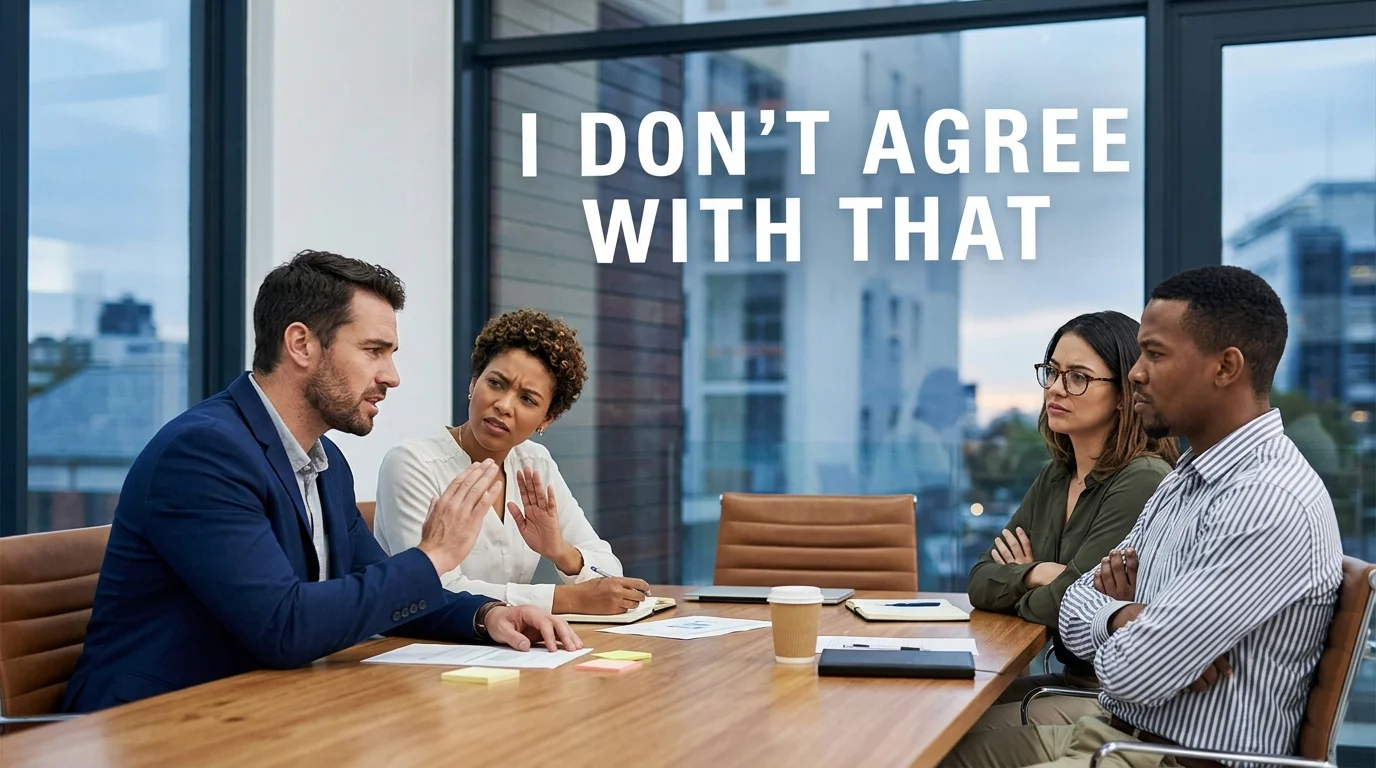
I Don’t Agree With That
Meaning: This is a straightforward way to state that you reject or do not share another person’s opinion.
Why This Phrase Works: It is easy to understand and does not carry the aggressive flavor of a slang insult.
Real-World Usage Insight: It works well when clarity matters more than humor.
Best Use: Meetings, conversations, emails, and discussions.
Avoid When: You specifically want playful banter.
Tone: Direct, neutral, conversational.
US vs UK Usage: Widely understood in both varieties.
Example (Email): “I don’t agree with that interpretation of the results, so I’ve included the original figures below for comparison.”
I See It Differently
Meaning: This expression indicates that you have another perspective rather than simply rejecting the other person’s view.
Why This Phrase Works: It softens disagreement and encourages further discussion.
Real-World Usage Insight: It is particularly effective when preserving a working relationship matters.
Best Use: Professional discussions, feedback, teamwork, and sensitive conversations.
Avoid When: You need to make a very firm rejection.
Tone: Diplomatic, calm, collaborative.
US vs UK Usage: Natural in both American and British English.
Example (Meeting): “I see it differently. The delay may actually give us enough time to improve the onboarding process.”
I Have a Different View
Meaning: This phrase states that your interpretation or opinion differs from another person’s.
Why This Phrase Works: It expresses disagreement without sounding hostile.
Real-World Usage Insight: It is useful when several reasonable perspectives exist.
Best Use: Workplace communication, discussions, reviews, and presentations.
Avoid When: A highly casual response is expected.
Tone: Neutral, professional, thoughtful.
US vs UK Usage: Used in both American and British English, with no major difference in meaning.
Example (Email): “I have a different view on the proposed timeline. I think moving the launch by one week would reduce the remaining risks.”
That’s Not How I See It
Meaning: This phrase tells someone that your understanding or interpretation is different from theirs.
Why This Phrase Works: It focuses on personal perspective rather than declaring that the other person is simply wrong.
Real-World Usage Insight: It is useful for disagreements where the facts or circumstances can reasonably be interpreted in different ways.
Best Use: Conversations, meetings, and professional discussions.
Avoid When: You need a precise statement supported by evidence.
Tone: Calm, conversational, moderately diplomatic.
US vs UK Usage: Commonly understood in both varieties.
Example (Conversation): “I understand why you think the meeting went badly, but that’s not how I see it. We actually resolved two important issues.”
I’m Not Convinced
Meaning: This expression indicates that the available argument or evidence has not persuaded you.
Why This Phrase Works: It leaves the door open for additional information rather than ending the conversation.
Real-World Usage Insight: It is especially useful when you want someone to provide stronger reasoning or evidence.
Best Use: Meetings, debates, reviews, and analytical discussions.
Avoid When: You have already made a final decision and need to communicate it clearly.
Tone: Skeptical, measured, professional.
US vs UK Usage: Natural in both American and British English.
Example (Meeting): “I’m not convinced the cheaper option will save money over the full year. Can we review the maintenance costs?”
I’ll Prove You Wrong
Meaning: This phrase expresses confidence that you can demonstrate that another person’s prediction or statement is incorrect.
Why This Phrase Works: It preserves the competitive energy of “Eat My Shorts” without using the same pop-culture insult.
Real-World Usage Insight: It can be motivating in friendly competition but may sound confrontational in serious discussions.
Best Use: Friendly challenges, sports, competitions, and playful conversations.
Avoid When: Speaking to a customer, supervisor, or someone discussing a sensitive issue.
Tone: Competitive, confident, challenging.
US vs UK Usage: Commonly understood in both American and British English.
Example (Social Media): “Everyone said I wouldn’t finish the challenge this month. I’ll prove you wrong.”
Just Wait and See
Meaning: This phrase asks someone to wait until future results demonstrate whether your prediction or confidence is justified.
Why This Phrase Works: It communicates confidence without directly insulting the other person.
Real-World Usage Insight: It works particularly well when you cannot prove your position immediately.
Best Use: Casual conversations, predictions, friendly challenges, and social media.
Avoid When: The audience needs immediate evidence or a detailed explanation.
Tone: Confident, teasing, suspenseful.
US vs UK Usage: Common in both varieties of English.
Example (Conversation): “You think the garden won’t survive the summer? Just wait and see. I’ve changed the watering schedule.”
I’ve Got This
Meaning: This phrase tells someone that you believe you can manage or complete a task yourself.
Why This Phrase Works: It communicates confidence without directing hostility toward another person.
Real-World Usage Insight: It can replace a defiant response when the real message is simply that you are capable of handling the situation.
Best Use: Work, everyday conversations, teamwork, and challenging tasks.
Avoid When: You genuinely need assistance and should communicate that need.
Tone: Confident, reassuring, casual.
US vs UK Usage: Very common in both American and British English.
Example (Meeting): “You don’t need to stay late to help with the report. I’ve got this.”
Conclusion
“Eat My Shorts” is a distinctly informal expression used to communicate defiance, disagreement, dismissal, or playful resistance. Its meaning is rarely literal, and its tone depends heavily on the relationship between speakers and the situation in which it appears. Because the phrase became widely recognized through The Simpsons, it also carries a strong pop-culture association, particularly in American English.
While it can work well in humorous conversations, social media posts, friendly banter, and other casual settings, it is generally unsuitable for professional, academic, legal, or sensitive communication. In those situations, alternatives such as “I respectfully disagree,” “I see it differently,” “I’m not convinced,” or “I have a different view” can communicate the intended message more clearly and respectfully. Understanding these differences helps speakers choose language that matches their audience, purpose, and level of formality. For ESL learners and content writers, recognizing the phrase’s tone is especially important because its cultural meaning goes beyond its literal words.
FAQs
What does “Eat My Shorts” mean?
“Eat My Shorts” is an informal expression used to show defiance, disagreement, or dismissal. It is generally humorous or sarcastic rather than literal. The phrase is strongly associated with Bart Simpson from The Simpsons and is most appropriate in casual situations. Depending on context, it can communicate a message similar to “I disagree” or “I challenge you.”
Is “Eat My Shorts” a rude phrase?
“Eat My Shorts” can sound rude or disrespectful, especially when directed at someone in a formal or serious situation. Among close friends, it may be understood as playful teasing. However, the phrase can appear confrontational when the relationship is unfamiliar, or the discussion involves work, authority, criticism, or sensitive subjects.
Is “Eat My Shorts” professional?
No, “Eat My Shorts” is generally considered an informal slang expression rather than professional language. It may be unsuitable for workplace emails, presentations, business meetings, academic writing, or customer communication. Professional alternatives such as “I respectfully disagree,” “I see it differently,” or “I’m not convinced” provide a clearer and more appropriate way to express disagreement.
Where did the phrase “Eat My Shorts” come from?
“Eat My Shorts” became especially famous through The Simpsons, where Bart Simpson frequently uses the expression. Although similar humorous forms of exaggerated slang existed before the television series, Bart’s repeated use helped make the phrase widely recognizable. It is now strongly connected with American pop culture and informal rebellious humor.
Is “Eat My Shorts” an insult?
“Eat My Shorts” can function as a mild insult or dismissive remark, although its seriousness depends on context and delivery. Between friends, it may simply communicate playful defiance. When used toward a stranger, manager, teacher, customer, or colleague, however, it can sound disrespectful because it directly rejects the other person’s statement.
What are polite alternatives to “Eat My Shorts”?
Polite alternatives include “I respectfully disagree,” “I see it differently,” “I have a different view,” “I understand your point, but I disagree,” and “I’m not convinced.” These expressions communicate disagreement without the sarcastic or rebellious tone associated with “Eat My Shorts,” making them more appropriate for professional and sensitive conversations.
Can “Eat My Shorts” be used in an email?
It can be used in a personal email when the recipients have a close relationship, and the context is clearly humorous. It should generally be avoided in professional emails because the recipient may interpret it as disrespectful. For workplace communication, phrases such as “I see it differently” or “I have a different perspective” are safer choices.
What is a funny alternative to “Eat My Shorts”?
Funny alternatives include “You wish,” “Yeah, right,” “Not a chance,” and “Says who?” “Just wait and see,” and “Bring it on.” These expressions can communicate playful disagreement or confidence without using the exact phrase. Their appropriateness still depends on the relationship, audience, and tone of the conversation.
Is “Eat My Shorts” American or British English?
“Eat My Shorts” is strongly associated with American English and American popular culture, particularly because of The Simpsons. British English speakers may recognize the phrase because the show has an international audience, but it is not necessarily a common everyday British expression. In both American and British English, it remains highly informal.
Can ESL learners use “Eat My Shorts”?
ESL learners can use “Eat My Shorts” when they understand its informal and potentially sarcastic tone. It is safest in casual conversations with people who recognize the expression and understand the intended humor. In academic, professional, or formal communication, ESL learners should generally choose clearer alternatives such as “I disagree” or “I see it differently.”

