
Imagine explaining a project idea to a colleague, only to hear them summarize it in a completely different way. You might respond, “That is not it at all.” The sentence immediately signals that the other person has misunderstood your meaning, intention, or situation.
“That Is Not It At All” is commonly used when someone wants to correct an inaccurate interpretation or make it clear that something is substantially different from what another person has suggested. Depending on the speaker’s tone, it can sound calm and corrective, surprised, frustrated, or emphatic.
In modern communication, choosing the right alternative matters because the same basic message can sound either collaborative or confrontational. Professionals may prefer expressions such as “That’s not quite what I meant” when they want to correct someone without creating tension, while casual speakers may use “That’s not it” or “That’s not what I’m saying.” Understanding these distinctions helps professionals, students, ESL learners, writers, and content creators communicate disagreement with greater precision.
What Does “That Is Not It At All” Mean?
“That Is Not It At All” means that something someone has said, assumed, described, or understood is completely different from the intended meaning or actual situation. The phrase is generally used to correct a misunderstanding, reject an inaccurate interpretation, or emphasize that a proposed explanation does not match the speaker’s meaning. It can appear in conversations, meetings, emails, and discussions.
Origin & History of “That Is Not It At All”
“That Is Not It At All” does not have a documented single-point origin in the way that some well-known idioms or proverbs do. It is a naturally constructed English expression made from ordinary words: “that,” “is,” “not,” “it,” and the emphatic phrase “at all.”
The important linguistic feature is the combination of “not” with “at all.” In English, “not at all” has long been used to strengthen a negative statement. For example, “I do not agree at all” expresses a stronger disagreement than simply “I do not agree.”
The expression also reflects a common conversational pattern in English: identifying something as “it” and then explaining that the proposed interpretation is not “it.” Here, “it” can refer to an idea, intention, explanation, answer, situation, or understanding already established by the surrounding conversation.
Over time, expressions of this kind became particularly useful in spoken English because they allow speakers to correct misunderstandings quickly. The phrase does not necessarily reject the person; it primarily rejects the interpretation.
Modern communication has expanded its use into workplace discussions, emails, messaging apps, social media conversations, online debates, and collaborative projects. However, because the wording can sound emphatic, speakers often choose softer alternatives when they want to preserve rapport.
Synonyms & Alternatives by Tone
Professional & Neutral Alternatives
- That’s not quite what I meant.
- That’s not what I’m saying.
- That’s not the point.
- That’s not accurate.
- That’s not the case.
- That’s not how I see it.
- That doesn’t quite capture it.
Polite & Supportive Alternatives
- That’s not exactly what I meant.
- I think there may be a misunderstanding.
- Let me clarify what I mean.
- That’s slightly different from what I intended.
- I may not have explained that clearly.
Encouraging & Reassuring Alternatives
- That’s not quite the idea I had in mind.
- Let me explain what I was trying to say.
- I think we’re looking at this differently.
- There’s a little more to it than that.
Casual, Playful & Idiomatic Alternatives
- That’s not it.
- Nope, that’s not it.
- That’s not what I’m getting at.
- That’s not the picture.
- You’ve got the wrong idea.
- That’s way off.
- That’s not even close.
When Should You Use “That Is Not It At All”?
“That Is Not It At All” works best when you need to clearly correct a misunderstanding or reject an interpretation. It is particularly useful when the other person’s explanation is substantially different from what you intended.
Professional settings
In professional communication, the phrase can be used when a direct correction is necessary. For example, during a meeting, someone might summarize a proposal incorrectly, and you could say, “That’s not it at all. The goal is to reduce the number of steps, not remove the entire process.”
However, a softer alternative is often better when maintaining cooperation is important.
Casual conversations
The phrase is natural in everyday speech. Friends, family members, and acquaintances may use it when correcting an assumption.
For example:
“I thought you were upset with Sarah.”
“That’s not it at all. I was just tired.”
Writing, presentations, and digital communication
In writing, the phrase can make disagreement very clear, but the surrounding language determines how strong it sounds. In an email, “That’s not quite what I meant” is usually more diplomatic.
In social media discussions, “That’s not it at all” can sound emphatic and may be interpreted as dismissive if there is no additional explanation.
When it is especially effective
Use the phrase when:
- Someone has seriously misunderstood your point.
- You need to distinguish your actual meaning from an assumption.
- A proposed explanation is fundamentally incorrect.
- You want a concise correction.
- The conversational context already makes the meaning of “it” clear.
When Should You Avoid “That Is Not It At All”?
Although the phrase is grammatically natural, it is not appropriate for every situation.
Overly formal situations
Highly formal documents may benefit from precise wording instead.
Instead of:
“That is not it at all.”
Consider:
“The previous interpretation does not accurately reflect the intended meaning.”
Legal, academic, or sensitive contexts
In legal or academic writing, ambiguity can create problems. Because “it” depends heavily on context, a more specific statement is often preferable.
Instead of saying:
“That’s not it at all.”
You might write:
“That interpretation does not accurately represent the findings.”
Situations where nuance may be lost
Sometimes another person’s interpretation is partly correct rather than completely wrong. In that situation, “That Is Not It At All” may sound stronger than intended.
A better choice might be:
“That’s partly right, but there’s another aspect to consider.”
This distinction is especially important in workplace discussions, teaching, feedback, and emotionally sensitive conversations.
Is “That Is Not It At All” Professional, Polite, or Casual?
“That Is Not It At All” is generally neutral in vocabulary but emphatic in tone. It is not inherently rude, but its emotional effect depends heavily on delivery and context.
In spoken English, stress on “not” or “at all” can sound firm. A relaxed voice can make it sound like a simple clarification, while a sharp delivery may make it feel dismissive.
In professional communication, the expression is acceptable when the situation calls for direct correction. However, “That’s not quite what I meant” usually creates less interpersonal friction.
The phrase can communicate:
- Strong disagreement
- Correction
- Surprise
- Frustration
- Clarification
- Rejection of an interpretation
The key issue is not grammar but pragmatic force: how the listener understands the speaker’s intention from the words, context, and delivery.
Pros and Cons of Using “That Is Not It At All”
Advantages
- Clarity: It immediately indicates that the interpretation is incorrect.
- Efficiency: It corrects a misunderstanding without requiring a long explanation.
- Accessibility: The vocabulary is simple and understandable to most English speakers.
- Emphasis: “At all” makes the strength of the disagreement clear.
- Conversational naturalness: It sounds authentic in ordinary spoken English.
Potential Drawbacks
- Oversimplification: It can suggest that an interpretation is completely wrong when it may only be partly inaccurate.
- Tone mismatch: In sensitive situations, it may sound dismissive.
- Repetition: Repeatedly using strong correction phrases can make conversations feel argumentative.
- Context dependence: The word “it” may be unclear without surrounding information.
- Limited formality: It may not be the best choice for highly formal writing.
Real-Life Examples of “That Is Not It At All” by Context
Emails
“I reviewed the notes from yesterday’s meeting. That’s not it at all. We agreed to test the new workflow with one team first, not roll it out company-wide.”
Meetings
“That’s not it at all. The issue isn’t the budget; it’s the timeline.”
Presentations
“If you think this slide is about increasing sales immediately, that’s not it at all. The main objective is to improve customer retention.”
Conversations
“I thought you didn’t want to come because you were angry.”
“That’s not it at all. I just had too much going on today.”
Social media
“That’s not it at all. The post is about how the policy affects small businesses, not about opposing the entire policy.”
“That Is Not It At All” vs Similar Expressions
The following expressions all communicate some form of correction, but their strength, emotional tone, and intended use are different.
| Phrase | Meaning Difference | Tone Difference | Best Use Scenario |
| That’s not quite what I meant. | Says the interpretation is somewhat different from the intended meaning. | Polite and diplomatic. | Workplace discussions and emails. |
| That’s not what I’m saying. | Corrects what someone believes you are arguing or communicating. | Neutral but firm. | Discussions, debates, and meetings. |
| That’s not the point. | Says the other person has focused on the wrong issue. | Direct and corrective. | Discussions where the main issue needs refocusing. |
| That’s not the case. | Rejects a claim about a situation or fact. | Professional and factual. | Business, academic, and formal discussions. |
| That’s not exactly what I meant. | Indicates that the interpretation is close but inaccurate. | Soft and diplomatic. | Feedback, emails, and conversations. |
| I think there’s a misunderstanding. | Identifies a communication problem rather than simply rejecting the other person’s statement. | Collaborative and polite. | Sensitive or professional situations. |
Common Mistakes & Misuse of “That Is Not It At All”
Overuse
Using the phrase every time someone disagrees can make communication unnecessarily forceful. It is better reserved for situations where the misunderstanding is significant.
Incorrect context
The phrase should not automatically be used to reject factual information. If someone says something factually incorrect, a specific correction is usually clearer.
Instead of:
“That’s not it at all.”
Say:
“The date was actually moved to Thursday.”
Contradictory usage
Avoid saying “That’s not it at all” and then agreeing with most of the statement. If the other person is partially correct, acknowledge that part.
For example:
“You’re right about the deadline, but that’s not the main issue.”
Cultural misunderstandings
ESL learners should remember that directness varies between cultures and professional environments. A phrase that sounds like normal correction in one conversation may sound confrontational to someone who expects more indirect communication.
Adding a brief explanation can soften the impact:
“That’s not quite it. What I meant was…”
Psychological Reason People Prefer “That Is Not It At All”
Cognitive load reduction
Short expressions are useful when people need to correct information quickly. “That’s not it at all” tells the listener immediately that the previous interpretation should be reconsidered.
Trust and authority signals
Clear corrections can demonstrate that a speaker knows what they intended to communicate. However, authority is more effective when directness is balanced with explanation.
Attention economy
Modern communication often happens quickly through short messages, notifications, chats, and comments. Compact expressions can communicate a correction without requiring several sentences.
Modern communication habits
People increasingly use conversational English in professional environments. Expressions once associated primarily with speech now appear regularly in Slack messages, emails, workplace chats, and social platforms.
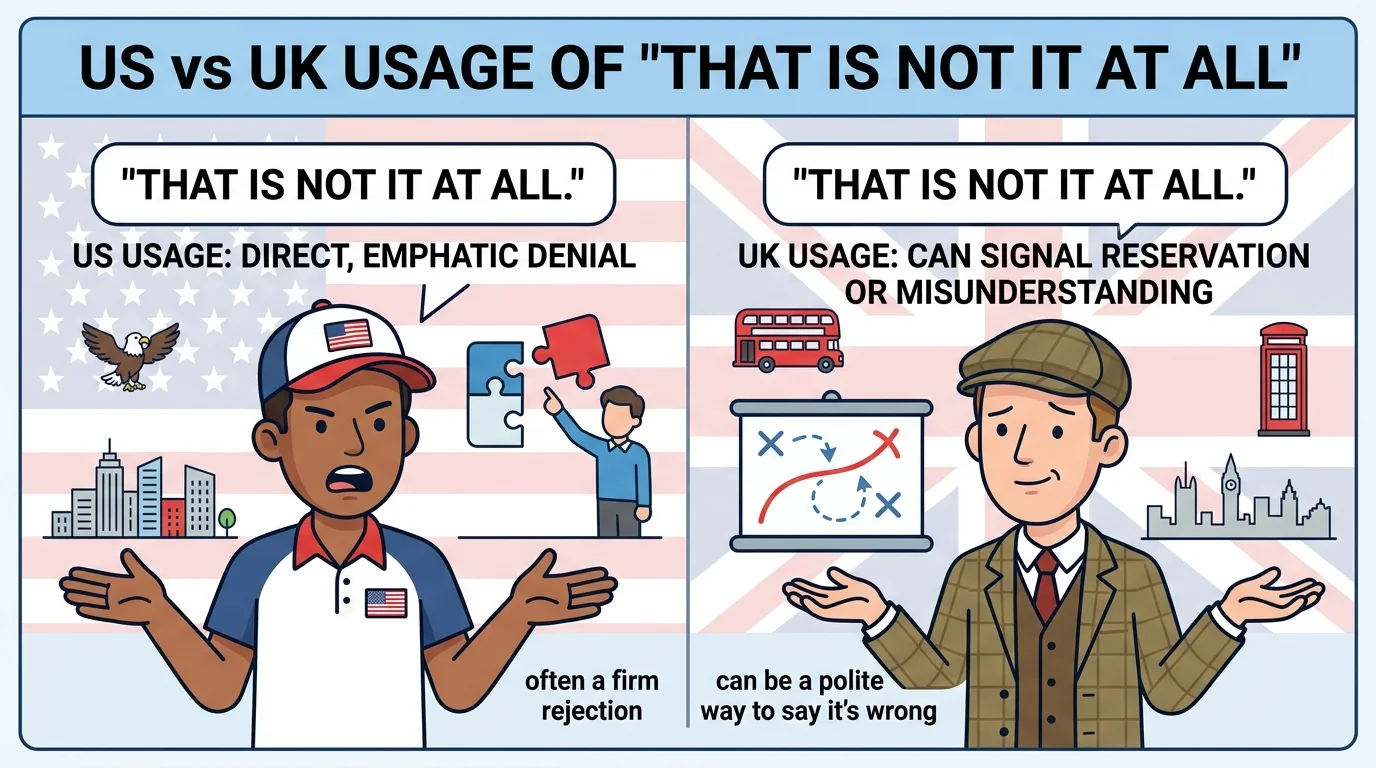
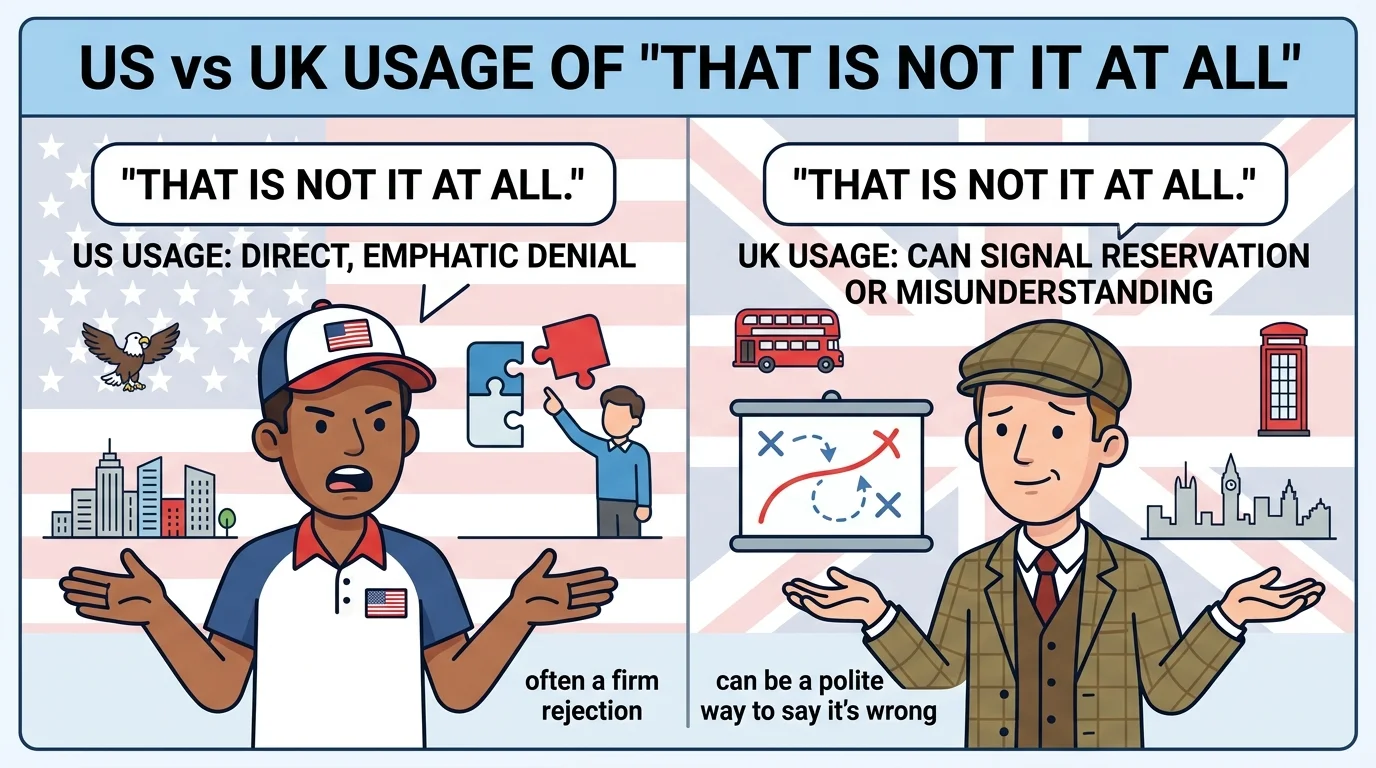
US vs UK Usage of “That Is Not It At All”
“That Is Not It At All” is understandable and natural in both American and British English. There is no major difference in its basic meaning between the two varieties.
In both US and UK English, the phrase can sound emphatic because of “not” and “at all.” The surrounding context and speaker’s delivery usually matter more than regional grammar.
American speakers may commonly use shorter forms such as “That’s not it” or “That’s not what I mean,” while British speakers may also use expressions such as “That’s not quite what I meant” or “That’s not really the point.” These are broad tendencies rather than strict regional rules.
Professional environments in both countries generally favor more specific or diplomatic wording when disagreement could create tension.
“That Is Not It At All” in Digital & Modern Communication
Emails
Email requires extra attention to tone because the recipient cannot hear the speaker’s voice. “That’s not it at all” may sound stronger in writing than it would in conversation.
Slack / WhatsApp
Short forms are common in messaging. “That’s not it” or “That’s not what I meant” can work naturally when participants already understand the context.
Social media
The phrase can be useful when correcting a public misunderstanding, but it may also sound dismissive if the speaker does not explain.
AI-generated summaries
AI-generated summaries can sometimes simplify a nuanced statement. When correcting such a summary, a precise explanation is more useful than simply saying, “That’s not it at all.”
For example:
“That summary misses the main distinction. I was discussing the implementation process, not rejecting the proposal itself.”
Linguistic & Communication Insight
Emotional weight & subtext
The literal meaning is straightforward, but native speakers often perceive an additional layer of emphasis. The words “not” and “at all” make the correction stronger than a simple “That’s not it.”
The phrase can therefore communicate more than factual disagreement. Depending on context, it may suggest surprise, frustration, urgency, or a desire to correct the record immediately.
Direct vs indirect phrasing
“That’s not it at all” is relatively direct. It tells the listener that the proposed interpretation is substantially wrong.
A softer alternative such as “That’s not quite what I meant” gives the listener more room to revise their interpretation without feeling directly rejected.
The difference can be important in collaboration. Direct language is useful when precision is urgent, while indirect wording can be more effective when preserving cooperation is equally important.
Professional communication perspective
In a workplace, the phrase can be perfectly understandable but may require context. If a manager says, “That’s not it at all,” employees may interpret the statement as a strong rejection of their understanding.
A more constructive version could be:
“That’s not quite what I had in mind. Let me explain the goal.”
The second version still corrects the misunderstanding while making the next step collaborative.
Pragmatic reasons for alternatives
Experienced communicators often choose alternatives because communication is not only about transferring information. It also involves managing relationships.
For example:
“That’s not accurate.”
is direct and factual.
“I think there may be a misunderstanding.”
focuses on the communication problem.
“That’s not quite what I meant.”
Focuses on the speaker’s intended meaning.
Each sentence handles the same general problem differently.
Social signaling
Word choice influences how listeners perceive confidence, openness, and cooperation. A strong correction can signal certainty, while a softer correction can signal willingness to continue the discussion.
This does not mean that one tone is always better. The appropriate choice depends on the purpose of the interaction.
Tone & context guidance
Use stronger wording when the distinction genuinely matters, and the audience understands the context.
Use softer wording when:
- The person is making a good-faith effort.
- The issue is sensitive.
- You are giving feedback.
- You want to encourage discussion.
- The misunderstanding is only partial.
- You are communicating with someone unfamiliar with your style.
Meaning, Usage & Examples for Each Alternative
That’s Not Quite What I Meant
Meaning: This expression means that another person’s interpretation is somewhat different from the speaker’s intended meaning. It corrects the misunderstanding without suggesting that the other person is completely wrong.
Why This Phrase Works: It places the focus on the speaker’s intended meaning rather than blaming the listener. This makes it especially useful when maintaining a cooperative relationship matters.
Real-World Usage Insight: Native speakers frequently use this phrase in professional conversations when they want to correct a colleague without sounding harsh.
Best Use: Emails, meetings, workplace feedback, collaborative writing, and professional conversations.
Avoid When: The other person’s interpretation is completely unrelated and a stronger correction is genuinely necessary.
Tone: Polite, professional, diplomatic, and moderately direct.
US vs UK Usage: Natural in both American and British English. It is widely understood in professional settings in both varieties.
Example (Email / Message / Meeting): “That’s not quite what I meant in the proposal. I’m suggesting that we test the process with a smaller group before expanding it.”
That’s Not What I’m Saying
Meaning: This phrase tells someone that their interpretation does not accurately represent the argument or idea the speaker is communicating.
Why This Phrase Works: It directly distinguishes the speaker’s actual message from an assumption made by someone else.
Real-World Usage Insight: It is particularly common during discussions where people are interpreting another person’s position.
Best Use: Meetings, debates, interviews, conversations, and online discussions.
Avoid When: You want an especially gentle correction with someone who may be sensitive to direct disagreement.
Tone: Direct, conversational, and firm.
US vs UK Usage: Common in both US and UK English with essentially the same meaning.
Example (Meeting): “That’s not what I’m saying. I’m not suggesting we cancel the project; I’m saying we should change the timeline.”
That’s Not the Point
Meaning: This expression means that the previous comment focuses on an issue that is not the main subject or purpose of the discussion.
Why This Phrase Works: It redirects attention toward the central issue instead of merely rejecting another person’s statement.
Real-World Usage Insight: It is useful when a conversation becomes focused on a secondary detail.
Best Use: Meetings, discussions, presentations, debates, and explanatory conversations.
Avoid When: The other person has raised a legitimate concern that deserves acknowledgment.
Tone: Direct and sometimes assertive.
US vs UK Usage: Common and natural in both varieties of English.
Example (Meeting): “The cost is important, but that’s not the point. We’re trying to determine whether the new process actually saves time.”
That’s Not Accurate
Meaning: This phrase states that information, an explanation, or a description does not correctly represent the facts or situation.
Why This Phrase Works: It focuses on accuracy rather than the person who provided the information.
Real-World Usage Insight: Professionals often use it when correcting factual details, reports, summaries, or descriptions.
Best Use: Business communication, reports, presentations, academic discussions, and factual corrections.
Avoid When: The issue is primarily a difference in personal interpretation rather than factual accuracy.
Tone: Professional, factual, and direct.
US vs UK Usage: Widely used in both American and British English.
Example (Email): “The summary is helpful, but the final sentence isn’t accurate. The team approved a revised schedule rather than a complete cancellation.”
That’s Not the Case
Meaning: This phrase means that a particular situation, assumption, or claim does not apply to the circumstances being discussed.
Why This Phrase Works: It gives a concise and relatively formal way to reject an assumption.
Real-World Usage Insight: The phrase appears frequently in professional and informational communication where clarity is more important than emotional expression.
Best Use: Emails, reports, meetings, customer communication, and formal conversations.
Avoid When: You need to explain why the assumption is incorrect, and the audience may require more detail.
Tone: Neutral, professional, and factual.
US vs UK Usage: Common in both varieties of English.
Example (Email): “That’s not the case in this situation. The delay resulted from the supplier change, not from the internal review.”
Conclusion
“That Is Not It At All” is a clear and emphatic way to correct a misunderstanding, reject an inaccurate interpretation, or explain that something differs substantially from what was intended. Its simple wording makes it easy to understand, but its tone can change depending on the situation, relationship, and delivery. In professional settings, softer alternatives such as “That’s not quite what I meant,” “That’s not exactly what I meant,” or “Let me clarify what I mean” can help maintain a cooperative tone.
More direct expressions may work better in casual conversations where strong emphasis is acceptable. Understanding these distinctions allows speakers and writers to communicate disagreement without creating unnecessary confusion. Whether you are writing an email, participating in a meeting, chatting with someone, or creating online content, choosing the right alternative helps make your message more precise, natural, and audience-appropriate.
FAQs
What does “That Is Not It At All” mean?
“That Is Not It At All” means that something someone has said, suggested, or understood is completely different from the speaker’s actual meaning or the situation being discussed. It is commonly used to correct a misunderstanding, reject an interpretation, or emphasize that an assumption is substantially incorrect.
Is “That Is Not It At All” grammatically correct?
Yes, “That Is Not It At All” is grammatically correct. In everyday conversation, speakers normally use the contraction “That’s not it at all.” The expression uses “not at all” to strengthen the negative statement, making the correction more emphatic than simply saying, “That’s not it.”
Is “That Is Not It At All” professional?
“That Is Not It At All” can be used professionally, but it may sound emphatic depending on the context. In emails and formal workplace conversations, “That’s not quite what I meant” or “That’s not exactly what I meant” is often more diplomatic while still communicating the necessary correction.
Is “That Is Not It At All” rude?
The phrase is not inherently rude, but it can sound blunt or dismissive when delivered sharply. Tone, context, and the relationship between speakers influence how it is received. Adding an explanation, such as “That’s not it at all; what I meant was…,” can make the correction clearer and more constructive.
What is a polite alternative to “That Is Not It At All”?
A polite alternative is “That’s not quite what I meant.” Other options include “That’s not exactly what I meant,” “I think there’s a misunderstanding,” and “Let me clarify what I mean.” These expressions correct the misunderstanding while reducing the risk that the listener will feel directly criticized.
What is a professional way to say “That Is Not It At All”?
In professional communication, “That’s not quite what I meant” is a useful choice because it is direct enough to correct the misunderstanding without sounding unnecessarily harsh. Depending on the context, “That’s not accurate,” “That’s not the case,” or “Let me clarify what I mean” may be more precise.
Can I use “That Is Not It At All” in an email?
Yes, but consider the relationship and purpose of the email. Because written communication lacks vocal tone, the phrase can sound stronger than intended. For workplace emails, “That’s not quite what I meant” is often safer. If a strong correction is necessary, follow the phrase with a concise explanation.
What is the difference between “That Is Not It At All” and “That’s Not Quite What I Meant”?
“That Is Not It At All” strongly suggests that the interpretation is completely wrong or substantially different. “That’s not quite what I meant” is softer and allows for partial understanding. The first is more emphatic, while the second is generally more suitable for polite professional communication and constructive feedback.
Can “That Is Not It At All” be used in casual conversation?
Yes. The phrase is natural in everyday spoken English when someone misunderstands an intention, situation, or explanation. For example, someone might say, “That’s not it at all. I wasn’t upset; I was just tired.” Its conversational quality makes it suitable for friends, family, and informal discussions.
What are the best synonyms for “That Is Not It At All”?
Useful alternatives include “That’s not quite what I meant,” “That’s not what I’m saying,” “That’s not exactly what I meant,” “That’s not the point,” “That’s not accurate,” “That’s not the case,” and “I think there’s a misunderstanding.” The best choice depends on the desired level of directness and formality.

